Archive | social learning RSS feed for this section

Stuck inside of mobile with the platform blues again

22 Jan

I hear it everywhere I go, in conversations with people who don’t know better and—more frustratingly—with people who should. Some variation of the themes laid down in this recent article from CMS Wire. Complete with a fine-looking infographic (which I’m a sucker for!), the author highlights trends in business communication. She points out the shift to a higher share of communications on mobile devices and internal tools (intranets and enterprise network solutions (ENS)), and away from face-to-face meetings.

She is correct on each point, and yet misses the point entirely.

The significant trends in our networked world aren’t about mobile, communication platforms and new devices. The “trends” in workplace communication are about why and how, not what and on which platform.

As I’ve discussed in this blog before, alongside and in the footsteps of those more expert than I, all that devices and platforms provide us with is a new gateway to discover, categorize, tag, share, synthesize and learn from the information at our fingertips. The hot new device of 2015, and whatever new platform your organization rolls out this year, doesn’t really matter. Devices and platforms are fleeting and will be gone by 2020.

The mental maps we create are the critical element in how we work/ learn.

The mental maps we create are the critical element in how we work/ learn.

The real change is between our ears, within organizations that are reconfiguring away from hierarchies and toward network-centered activities, and those who can learn—and make use of that learning—every day, individually and collectively.

I see this confusion raging even close to home in my own PLN in eLearning and L & D circles. “Mobile is the next big thing!” No, it isn’t. Mobile devices are becoming ubiquitous and we can’t ignore their significance in how we deliver learning experiences and performance support, but they are only a facet of what really is the next big thing: personal learning and how it intersects organizational and communal learning. The significance of “mobile vs. other” will be over by 2020 (along with email as primary work function, please!!), but the significance of learning practice as the tool for organizational and professional development is just getting off the ground.

Sooner or later, one of must know… sorry, couldn’t stop myself.

Thanks, Bob.

Thanks, Bob.

Moving from SMEs to LMPs: Learning Matter Practitioners.

13 Jan

There are countless resources on how to work with subject matter experts (SMEs). How to get the information you need from them. How to get their buy-in. How to negotiate what’s learning content from organized resources. How to help your SMEs understand how instructional designers do our jobs, and why. This battle for cooperation, if not partnership, with SMEs has been well-worn topic for a long time.

But in this new world of building learning landscapes and personal knowledge management (PKM) (what I call The Learning Age), we’d be better off if we approach the problem in a new way.

SMEs are just another node in a networked world/workplace. Let's work to integrate their expertise to be available to all.

SMEs are just another node in a networked world/workplace that includes data, workers and support systems. Let’s work to integrate their expertise to be available to all. 

Perhaps instead of wrangling content, divining applicable knowledge from content, and support information from noise, we should spend more time inviting SMEs into the world of networked learning. The days of heading to the mountain top to receive golden nuggets are over. Content is everywhere, information can be found—or at least should be able to be found—easily. Our SME is not the font of content, or knowledge, but of experience. That is, how the knowledge is applied effectively, efficiently, and with 360° understanding of the context.

In other words, we need to train our SMEs to become LMPs—learning matter practitioners. Not that they need to be great teachers or steeped in instructional design, but they do need to be taught how to share their work (WOL, work out loud!), deliver insights in useful, accessible ways, and be available to people across their organization and (perhaps) industry. If SMEs don’t document, share, comment, tweet, blog, and visit with others, then that is an area for learning practitioners to invest time and programming dollars.

This may require that most daring of high-wire acts, the change in workplace culture. Spoiler: The change is happening under our feet anyway. Let’s invite even the most siloed SME to join the emerging networked workplace.

Some now claim that 81% of workplace learners are responsible for managing their own professional development (PD), and 91% expect technology to enable quicker responses to learning/change conditions. Whatever the actual numbers may be, the trend toward individually initiated PD is clear. Whether SMEs know it or not, or are resistant or not, “traditional” SME status will only be as elevated as their ability to integrate hard-won experience into the dynamic, shape-shifting network of the modern workplace. Now that is a learning challenge for us to dig our hands into.

Note to Self: How ’bout a note to all?

29 Dec

We gather for our meeting. Some pull out laptop computers, others prefer pen and paper. We talk over our projects, progress, next steps, risk factors. It’s a scene that plays out every day, to the point where we barely think through the opportunity that each meeting might represent.

We head back to our desks or on to our next meeting. The most organized, resourceful, and determined among us will file notes into whatever organizing system we have devised. Perhaps they’ll reappear in the minutes before the moment of need, either as we work on that project or gather again. Rinse and repeat.

But what if we changed the cycle? What if those meeting notes were out in the open, cataloged for team members and colleagues—and managers and mentees—to find, save, share, and make sense of for their own personal knowledge management (PKM)? I’m proposing that we don’t just save our notes, but use them, share them, integrate them with others, and build both individual and organizational learning.

That kind of transparency has so many benefits:

  • Notes become living documents to add to and glean from.
  • Meetings are more focused, productive, and (maybe) less frequent when show your work/working out loud (#WOL) practices are systemically applied.
  • Managers, stakeholders, and cross-functional coworkers can benefit from knowledge of and insights from the ongoing notes.
  • Potential misunderstandings, cross-purposes, and redundancies can be avoided by sharing freely with teammates.
  • New insights can be found in the notes “feed” from all our of organization’s ongoing work.
  • It helps each of us make better sense of our daily activities.
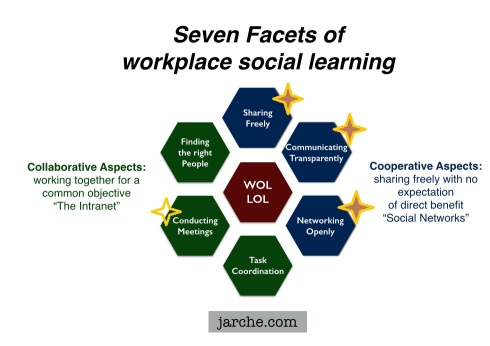
Open note-taking hits several keys of Working/Learning Out Loud. Click image to read H. Jarche's excellent post  and source for this graphic.

Open note-taking hits several keys of Working/Learning Out Loud. Click image to read H. Jarche’s excellent post and source for this graphic.

I hear misgivings and concerns about this practice all the time, and here’s are the three most common:

  1. We already have too much information coming at us, and I can’t take any more inbox filler. There are many ways to manage information, and I recommend that you skip email notifications of any kind. Instead, use wikis, social feeds, SharePoint, ESNs, Google Docs, some project management and CRM tools, etc. It is not hard, and need not clutter; in fact, sharing this way will make long, substantive email chains unnecessary. Ultimately, this is a de-cluttering exercise.
  2. I don’t have time, and we already have too many reporting requirements. There’s the famous story of the delivery driver who claims he is too busy to change his flat tire as he clunk-a-clunks down the street. This is a new way of working, yes, but it doesn’t really require any new skills—you can simply take notes on a public platform instead of a private one. This may not satisfy your reporting requirements, but it will surely save you time when you have to create those reports, and may even make some reports superfluous.
  3. Isn’t that what a CRM system is supposed to do for us? A social CRM would indeed do this, at least in part. Few of us, however, have access to and use a CRM tool in this way. I certainly don’t. I invite those kind readers who do to let me know about it, for the benefit of all of us.

Heads of state (or their staff) take detailed notes and keep diaries to be made public after their terms of service, so that we might make sense of and learn from their decisions and insights. Few of us, however, deal in statecraft, classified files, or even sensitive information. We can benefit from these insights and knowledge today. As Jane Bozarth rightly says, “Share is the new save.” If you note it, there is a good chance others can benefit from it, too. Please, share the wealth.

In a future post, already in draft, I’ll discuss some tools and processes, and invite others to share how they’ve shared notes. But if you want to share your tips, no need to waitI’ll include them in my post and give you credit (if you’d like it).

e-Liberate! Shall we agree to lose the e?

25 Nov

eLearning.

What does it mean to you? Check out the Wikipedia definition: Clear as eMud.

At some point in my career I was certainly an eLearning (e-learning? elearning?) professional, even an evangelist. Not anymore. Not that I think there is anything wrong with what eLearning has traditionally been, per se, but just that we have moved beyond the e’s usefulness as a signifier.

As I’ve argued on several occasions, learning is our job, and we all are swimmers in the vast digital sea. Whatever eLearning means to us insiders, a large chunk of our learners and sponsors(!) imagine
e-courses to be clicked through as quickly as possible (if at all) so work can resume. The saddest bit of all is that a good portion of well-intentioned practitioners also think that way about the products we develop.

The Zombie E has had its day, but it is time we kill it.  Jawboneradio via flickr (http://bit.ly/1CbhDCq)

The Zombie E has had its day, but it is time we kill it.
Jawboneradio via flickr (http://bit.ly/1CbhDCq)

However, the shift is underway. I see it in the conferences I attend, via the PLNs I find so valuable, and in noble efforts like the Serious eLearning Manifesto. We now speak of learning experiences, and programmatic efforts to capture and share informal, ongoing, and “back-channel” learning. Through xAPI’s positive influence (more influence than practice at this point), Twitterstorms and organized peer hangouts, the means for professional growth are expanding. We are grappling—and sometimes succeeding—with how to integrate all of our training and learning events under the umbrella of learning practice.

So, what does the e mean? I really don’t know at this point. I no longer think of myself as an “eLearning” professional, but as a learning professional. Courses (tethered to an LMS or not), blended learning, live events, social media feeds, WOL/Show Your Work opportunities, PKM practice—these are all levers to be applied as the learning, professional development, and organizational goals dictate.

Digital delivery, via screens large and small (perhaps “mobile” needs to go, too?), takes the lion’s share of our work. And when live events occur, we work to integrate and amplify the strengths of the two together. So, it’s just learning, right?

Well, then: It’s time to embrace the future by losing the e.

Learning Guild? Learning Manifesto? Learning Industry? Yes, that’s what I’m suggesting. We are learning professionals, implementing learning programs.

Who’d have thunk that AOL’s “You’ve got mail!” (never email) slogan was ahead of its time?

I very much welcome your thoughts, rebuffs, and ideas on this topic. Leave a comment here, or find me at @BenCpdx.

WonderWOL: Why Work Out Loud?

13 Nov

Next week, November 17 to 21 is International Working Out Loud Week (WOL Week). Education Northwest, my organization, is one that has struggled at times to identify and implement the best ways to share knowledge and increase transparency across areas of work. We are not unique in that. I am hoping that the activities we’re rolling out for WOL Week will advance the cause.

What is WOL, aka Show Your Work? It’s a practice of simply documenting work and/or thoughts about that work, as it is happening or immediately after as an extension of the task. I hear you cringing: Great, more work?! Two short answers before I get into the more meaty whys below. 1. Once in the habit, this will save you work. 2. It’s kind of fun.

There are four main factors that, taken together, I think make a compelling case for doing some form of WOL.

  1. The speed of knowledge: Content is everywhere, data is all around, information streams at us constantly. Knowledge and its application – synthesized information that we can apply in meaningful ways – can run incredibly fast. Not just knowledge of a topic, field, or practice, but also knowledge of how to do things, in this workplace, and with the right tools and processes. WOL can help us keep up, by prompting us to document what we do and how we do it, and to have insight into other’s practices, too.
  2. The movement of people: Very few of us stay at an organization across years and decades anymore (and in this regard, Education Northwest’s staff longevity is an exception to other places I’ve been). Even if we do, the job that we do today isn’t the same as the job we did five years ago or will do five years from now (and if it is, ask WHY!?!). WOL practice is a way to document what we do and how we do it, and helps retain institutional memory and accelerate best practices.
  3. Learning is our primary task: As I’ve argued on numerous occasions, learning is our job: Working is learning, learning is working. See points 1 and 2 above. If we don’t have a method to keep up and keep learning, we are left behind, as individuals in the workforce and in our organizations.
  4. Loss of people whose job it is to know how to get things done: Watch any TV show set
    They knew how to actually get work done, but that' s a by-gone era (for better, mostly). amctv.com

    They knew how to actually get work done, but that’ s a by-gone era (for better, mostly). amctv.com

    in the workplace before 1995, and you’ll see the cadre of people who actually know how to get things done. They were called admins, support staff, interns or junior staff. (In a way Education Northwest is an exception here, too – I’m grateful for the terrific support staff we have.) Need to pull reports? Send a letter to the board? Work the system to get a contractor paid? Now we are meant to be self-reliant. That is, responsible for our professional development and subject AND how to get things done. That’s our world. WOL practices are a great way to address that, too. People are notoriously bad at describing what they actually do to get things done – it’s tucked away between the ears. I don’t know how to get a contractor’s payment though HR and payroll, but surely someone in my organization does and may have shared that info. See? It saves you time!

There are all kinds of reasons to give WOL a try. Don’t worry if you don’t know your hashtags from your hash browns. Use whatever works for you – write a sticky note, take a picture of it, and send it to your colleagues. Join me and the (tens of?) thousands of folks who understand that we need new and better ways to share with each other in our workplaces and across our professions.

#WOL

#WOLWeek