Why tweet, and who gives a hoot? What Twitter does for me

30 Jan

I read, write and think about learning, knowledge management and collaborative work — it’s a lot to keep up with.

My Personal Learning Network (PLN) and Personal Knowledge Management/Mastery (PKM) practice has become vital to my professional growth . Of all the things I do in support of these efforts — blog, write articles, read, synthesize (what PKM calls “sense-making”), share, meet, respond and react — it is Twitter that I get the most questions, doubt, and even hostility about.

I want to share here why I use Twitter, and how it helps me.

I begin by saying I was late to it. I was skeptical, and more than a little derisive about those tweeters constantly tethered to their phones. I did not dive in: I was hesitant, lurking, dipping my toes in one digit at time. So, to you doubters, I was there with you not long ago.

Now, in two-years’ time, I can’t imagine my professional life without it!

With that said, it is NOT about Twitter itself. Twitter is a tool, like a hammer or a saw — they are useless until used purposefully. Twitter will be gone in 5 (or 10?) years, replaced by something(s) else. While I have found great value in applying Twitter to develop my PLN, it needn’t have been Twitter. It just worked well for me. You might find another tool that works for you. Great! It is the practice, not the tool.

Some ways I use Twitter to propel “real” work:

  • Capture thoughts and notes in real time, often with a hashtag (#, as in #learning) to help categorize it for myself and others.
  • Share and “favorite” useful tweets to let the most pertinent comments rise to the top and become easy to find.
  • Find like-minded people across the hall, or across the globe, with whom to share and learn. I have built my PLN from scratch, relying on Twitter for 90% of it. There is generally a true spirit of generosity and openness that’s remarkable.
  • Follow and learn from experts and leaders, to see what they are thinking, reading and see who they are following. Because Twitter is a-symmetrical (unlike Facebook, for example) you can follow anyone without the need for that person to reciprocate. (This difference was articulated nicely by Harold Jarche, which — and whom — I found via Twitter.) I follow @BarackObama, but he doesn’t follow me… yet!
  • Twitter storms. A synchronous (live) twitter event around a particular topic, these are generally moderated in a Q/A format with some opportunity for intros and self-promotions. Twitter storms are extremely useful to share and hear ideas, “meet” new like-minded people, and enjoy some PD time. Best of all, the transcripts are available after to remember and reflect on the storm’s activity.
  • Like Twitter storms, tweeting during — yes during! — live events, classes and sessions proves to be very useful. It creates a “back-channel” to help make sense of the information, and adds instant and long-lasting value by providing insights into what others make of it. In addition, it is a great way for me to experience an event even if I’m not there. It is so valuable!

The most common reservations I hear:

Who cares what I think? I care what I think (or thought last week or last year). You also might. And if not, that’s fine too. It is a micro-blog tool, a way to share thoughts and activities. The value is in the stream to reflect upon later, to discover others who cared, reactions to forming ideas and activities as they grow. When you share an idea or thought, you never know how others — or even you, after some time passes — will react. I saw Dr. deGrasse-Tyson stop, mid-talk, to tweet a thought. If it is worth noting, it’s worth saving. And, if worth saving, it’s worth sharing.

What can you learn from 140 characters? It’s not enough! Enough for what? To jot a note? Or ask a colleague a question? Or refer your friend to an article or video you found? 140 characters is plenty. In fact, I have found over time that the space limit actually helps sharpen my writing — and thoughts — down to essentials. Remember: It is not a replacement for other forms of communication!

It’s a fad that’s going away. As I say above, it’s true: If we’re still using Twitter 10 years from now, I’ll be quite surprised. The same is also true of Facebook, email (please, let it be so!!), and wired telephones (who has long phone conversations anymore!?). Tools come and go, but building PLN and PKM practice will remain.

It’s too informal. It’s frivolous. Depends on who’s wielding the tool. It can be feathery light or as serious as life-and-death (literally, as #BlackLivesMatter showed).

– I don’t have time. If you find it useful, you’ll have time. You don’t have time to change a tire on your car on your way to work, unless you need to change the tire.

Find me @BenCpdx… I’ll leave the bird on for you. If I’m the recipient of your first tweet, it would be an honor and I promise to reply.
bdc twitter

Stuck inside of mobile with the platform blues again

22 Jan

I hear it everywhere I go, in conversations with people who don’t know better and—more frustratingly—with people who should. Some variation of the themes laid down in this recent article from CMS Wire. Complete with a fine-looking infographic (which I’m a sucker for!), the author highlights trends in business communication. She points out the shift to a higher share of communications on mobile devices and internal tools (intranets and enterprise network solutions (ENS)), and away from face-to-face meetings.

She is correct on each point, and yet misses the point entirely.

The significant trends in our networked world aren’t about mobile, communication platforms and new devices. The “trends” in workplace communication are about why and how, not what and on which platform.

As I’ve discussed in this blog before, alongside and in the footsteps of those more expert than I, all that devices and platforms provide us with is a new gateway to discover, categorize, tag, share, synthesize and learn from the information at our fingertips. The hot new device of 2015, and whatever new platform your organization rolls out this year, doesn’t really matter. Devices and platforms are fleeting and will be gone by 2020.

The mental maps we create are the critical element in how we work/ learn.

The mental maps we create are the critical element in how we work/ learn.

The real change is between our ears, within organizations that are reconfiguring away from hierarchies and toward network-centered activities, and those who can learn—and make use of that learning—every day, individually and collectively.

I see this confusion raging even close to home in my own PLN in eLearning and L & D circles. “Mobile is the next big thing!” No, it isn’t. Mobile devices are becoming ubiquitous and we can’t ignore their significance in how we deliver learning experiences and performance support, but they are only a facet of what really is the next big thing: personal learning and how it intersects organizational and communal learning. The significance of “mobile vs. other” will be over by 2020 (along with email as primary work function, please!!), but the significance of learning practice as the tool for organizational and professional development is just getting off the ground.

Sooner or later, one of must know… sorry, couldn’t stop myself.

Thanks, Bob.

Thanks, Bob.

Moving from SMEs to LMPs: Learning Matter Practitioners.

13 Jan

There are countless resources on how to work with subject matter experts (SMEs). How to get the information you need from them. How to get their buy-in. How to negotiate what’s learning content from organized resources. How to help your SMEs understand how instructional designers do our jobs, and why. This battle for cooperation, if not partnership, with SMEs has been well-worn topic for a long time.

But in this new world of building learning landscapes and personal knowledge management (PKM) (what I call The Learning Age), we’d be better off if we approach the problem in a new way.

SMEs are just another node in a networked world/workplace. Let's work to integrate their expertise to be available to all.

SMEs are just another node in a networked world/workplace that includes data, workers and support systems. Let’s work to integrate their expertise to be available to all. 

Perhaps instead of wrangling content, divining applicable knowledge from content, and support information from noise, we should spend more time inviting SMEs into the world of networked learning. The days of heading to the mountain top to receive golden nuggets are over. Content is everywhere, information can be found—or at least should be able to be found—easily. Our SME is not the font of content, or knowledge, but of experience. That is, how the knowledge is applied effectively, efficiently, and with 360° understanding of the context.

In other words, we need to train our SMEs to become LMPs—learning matter practitioners. Not that they need to be great teachers or steeped in instructional design, but they do need to be taught how to share their work (WOL, work out loud!), deliver insights in useful, accessible ways, and be available to people across their organization and (perhaps) industry. If SMEs don’t document, share, comment, tweet, blog, and visit with others, then that is an area for learning practitioners to invest time and programming dollars.

This may require that most daring of high-wire acts, the change in workplace culture. Spoiler: The change is happening under our feet anyway. Let’s invite even the most siloed SME to join the emerging networked workplace.

Some now claim that 81% of workplace learners are responsible for managing their own professional development (PD), and 91% expect technology to enable quicker responses to learning/change conditions. Whatever the actual numbers may be, the trend toward individually initiated PD is clear. Whether SMEs know it or not, or are resistant or not, “traditional” SME status will only be as elevated as their ability to integrate hard-won experience into the dynamic, shape-shifting network of the modern workplace. Now that is a learning challenge for us to dig our hands into.

State Your Purpose: A few words about webinars

2 Jan

A speaker. A podium. A slide set. Information to disseminate. This is a fine scenario, and it is the paradigm on which webinars are built.

A: I have information.

B: You want that information.

C: I will share that information.

However, I think we all agree that the majority of webinars go off the rails pretty quickly. The reason for webinar-fail can be mostly categorized in five buckets:

  1. Poor presentation skills. There are many great resources to improve public speaking, slide design, and delivery. I rather like Slide:ology and The Webinar Manifesto, among many other great resources. Some folks are just not cut out for public speaking. There’s no shame in that. However, this is not my concern here.
  2. Technical problems. Yes, it happens, but not as often as you might think. Learn your platform and plan for worst-case events. That’s not my area of expertise.
  3. Poor understanding of the medium. A webinar compels participants to sit at their computer, watch and listen. That’s a personal-space environment. Don’t expect learners to pay attention for more than 15 minutes if they are not at their own screen, headphones on or in a very quiet room, alone. Groups gathered together to “watch” the webinar—unless it is a highly produced presentation experience, a là Apple introducing the iPad—will fail. (And, don’t get me started on anything that is planned for more than 60 minutes!) This is an oft-misunderstood element, and there is a lot of literature on how we act in groups versus as individuals, but that’s not what has my attention today.
  4. Wasted time. I attended a webinar recently of genuine interest, planned for an hour. There were 15 minutes of housekeeping, introductions, bios, and “setup.” Really? I can read bios and setup before, or after. Get to the topic! They lost me at “I’ll allow each of the four speakers to introduce themselves.” Again, I refer you to The Webinar Manifesto and numerous other books, blogs, articles, videos, and (yes!) webinars.
  5. Designers conflate dissemination, instruction, and learning. This is what I want to talk about.

Dissemination ≠ Instruction

As trainers are fond of saying: Telling Ain’t Training! If you’d like to share some news, build excitement for an initiative, or get all your scattered team members on the same project timeline, webinars are extremely useful. But if you’d like to train folks on the new CRM, or regulatory process, or how to avoid slips, trips, and falls in the warehouse, there are much better ways. At best, a webinar is part of a larger program. There is a reason that the phrase I’ve told you a hundred times! is so common. Telling is for the teller’s benefit, not the ones being told.

Instruction ≠ Learning

Learning happens by, and through, the learner. No matter how sound your instruction, how skilled a teacher, whether in a live classroom, via webinar, or in one-on-one coaching, learning happens when learners take new information or skills, filter and synthesize with their own experience and reference points, and apply it productively. No webinar is going to do that. There are ways to design learning experiences in which learners can demonstrate and apply lessons in real time. It takes good instructional design and a lot of skill to pull off. Alternatively, or in addition, you can observe or measure how the content you deliver is applied. In some cases there are hard metrics, but in most cases assessment will be anecdotal and iterative. You see, learning is a process that is ongoing, not an event. A stand-alone webinar is an event, useful for many things, but not to demonstrate that learning has occurred. If that is your goal … well, some design thinking is in order.

So, the when you plan your next webinar, think through:

  • The objective. If it involves words like teach, train, instruct, or educate, a webinar is at best a piece of a larger instructional program. If it is to inform, prepare, share, discuss, or gather feedback, you’re setting yourself up for success.
  • The attendees’ experience. What will the participants do during your time together? If it is sit and watch, don’t plan for longer than 20 minutes. We live in an interconnected, ultra-distracted world: Holding anyone’s attention longer that it takes to read this post is asking a lot. (If you’ve read this far, thanks!) There are ways to flip the webinar, that is, to do pre-work so that time online together is spent clarifying, discussing, and answering questions (for 20 minutes). Fewer slides, more talk/chat.
  • The purpose. If your purpose really is to train or teach, then design the learning experience. Again, this is not unique to the webinar medium, but participants are especially disinclined to sit through a webinar that is not useful.

A big thank you to Roger Courville, The Virtual Presenter, for his review and suggestions on this post. Check out his excellent blog and get a free copy of his handy book 102 Tips for Online Meetings.

Note to Self: How ’bout a note to all?

29 Dec

We gather for our meeting. Some pull out laptop computers, others prefer pen and paper. We talk over our projects, progress, next steps, risk factors. It’s a scene that plays out every day, to the point where we barely think through the opportunity that each meeting might represent.

We head back to our desks or on to our next meeting. The most organized, resourceful, and determined among us will file notes into whatever organizing system we have devised. Perhaps they’ll reappear in the minutes before the moment of need, either as we work on that project or gather again. Rinse and repeat.

But what if we changed the cycle? What if those meeting notes were out in the open, cataloged for team members and colleagues—and managers and mentees—to find, save, share, and make sense of for their own personal knowledge management (PKM)? I’m proposing that we don’t just save our notes, but use them, share them, integrate them with others, and build both individual and organizational learning.

That kind of transparency has so many benefits:

  • Notes become living documents to add to and glean from.
  • Meetings are more focused, productive, and (maybe) less frequent when show your work/working out loud (#WOL) practices are systemically applied.
  • Managers, stakeholders, and cross-functional coworkers can benefit from knowledge of and insights from the ongoing notes.
  • Potential misunderstandings, cross-purposes, and redundancies can be avoided by sharing freely with teammates.
  • New insights can be found in the notes “feed” from all our of organization’s ongoing work.
  • It helps each of us make better sense of our daily activities.
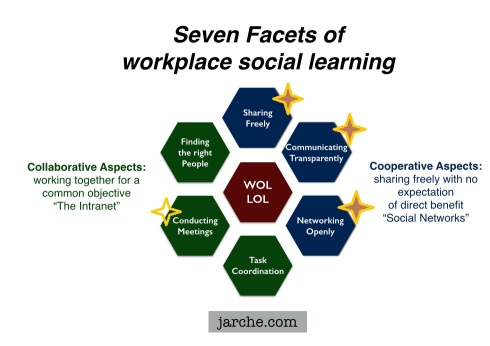
Open note-taking hits several keys of Working/Learning Out Loud. Click image to read H. Jarche's excellent post  and source for this graphic.

Open note-taking hits several keys of Working/Learning Out Loud. Click image to read H. Jarche’s excellent post and source for this graphic.

I hear misgivings and concerns about this practice all the time, and here’s are the three most common:

  1. We already have too much information coming at us, and I can’t take any more inbox filler. There are many ways to manage information, and I recommend that you skip email notifications of any kind. Instead, use wikis, social feeds, SharePoint, ESNs, Google Docs, some project management and CRM tools, etc. It is not hard, and need not clutter; in fact, sharing this way will make long, substantive email chains unnecessary. Ultimately, this is a de-cluttering exercise.
  2. I don’t have time, and we already have too many reporting requirements. There’s the famous story of the delivery driver who claims he is too busy to change his flat tire as he clunk-a-clunks down the street. This is a new way of working, yes, but it doesn’t really require any new skills—you can simply take notes on a public platform instead of a private one. This may not satisfy your reporting requirements, but it will surely save you time when you have to create those reports, and may even make some reports superfluous.
  3. Isn’t that what a CRM system is supposed to do for us? A social CRM would indeed do this, at least in part. Few of us, however, have access to and use a CRM tool in this way. I certainly don’t. I invite those kind readers who do to let me know about it, for the benefit of all of us.

Heads of state (or their staff) take detailed notes and keep diaries to be made public after their terms of service, so that we might make sense of and learn from their decisions and insights. Few of us, however, deal in statecraft, classified files, or even sensitive information. We can benefit from these insights and knowledge today. As Jane Bozarth rightly says, “Share is the new save.” If you note it, there is a good chance others can benefit from it, too. Please, share the wealth.

In a future post, already in draft, I’ll discuss some tools and processes, and invite others to share how they’ve shared notes. But if you want to share your tips, no need to waitI’ll include them in my post and give you credit (if you’d like it).