Archive | instructional design RSS feed for this section

Collaboration as Learning? Collaboration IS Learning (or certainly should be!)

9 Jul

I’ve discussed in earlier posts my strong belief that learning is based in discourse. Through conversation, examination, doubt and reaffirmation we arrive to that place where we are confident in our understanding, our knowledge that we’ve learned something significant. Even if it is internal dialog, there is no substitute for point – counter-point.

It seems like a logical extension then, that the waves of tools, systems and organizational necessities to make collaboration more effective would take us a good distance towards learning workers and learning organizations.  But, for many of us, that has been far from the case.

The more often I speak into a triangular phone, the more I stare at the moving mouse of a screencast or web meeting, the less I feel like I am collaborating (or learning!). Why? Peter Senge, the godfather of learning organizations, had an interesting post the other day about this very topic. Real Collaboration Takes More than Meetings and PowerPoints dives into the heart of this conundrum.

The main takeaway of his post is that collaboration takes deliberate effort, and a workplace culture that demands it. Collaboration should not be, in fact cannot be, passive.
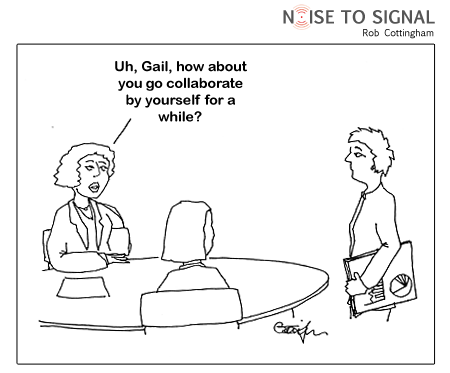
Rob Cottingham, via timesunion.com

Rob Cottingham, via timesunion.com

Collaboration is an act, a participation in a conversation that, if well-managed, drives to reveal facts and decision points. As Senge points out in one good example,

Practices for fostering thinking together need to be embedded in meetings as well. Whenever any of these networks meet, there are few “PowerPoint shows.” The vast majority of the time is spent in small working sessions and larger plenary dialogues….

Yes, our old friend dialog. It what makes the first Star Wars movie so much better than all the rest.

Hmmmm…. Active, engaged, participatory, the very opposite of passivity: Gosh, that sounds a lot like what trainers and Instructional Designers say all the time! Right, collaboration is learning when done well. If you have nothing to learn, and nothing to share, then why collaborate at all? The key is to manage the time, tools and cultural expectations to allow learning to happen.


Digital Curation as Learning Outcome

16 May

I was reading eLearning Magazine’s dispatches from the Learning Solutions 2013 conference, and appreciated a list they put together that encapsulated “Key Strategic Shifts to Watch.” After reading it through and giving it some thought, they really add up to one major shift in the way we should approach online learning: Learners taking control of their own learning.

I’ve touched on this topic before, but it warrants a deeper dive.

Information is not hard to find. Facts, ideas, hypotheses, art, opinions, stories, mendacities are impossible visitusto avoid. We are awash in digital content! There has been a lot of talk in the last decade of moving from “media literacy” to “digital literacy,” or what the terrific iDesign team at University of Alaska –Fairbanks have dubbed “Information Fluency.”

I could not agree more. Learners, from grade school through business leaders require the ability to sort through the sea of content to make sense of it all: Truth from fiction, actionable ideas from general knowledge, judgments from smears, opinions from facts. All of those are valuable content types—even smears—but through sorting comes understanding and eventually, knowledge.

But as I made the case before, knowledge is not my department.

What I am concerned about is how knowledge results in action (learning transfer). In other words, how does a learner demonstrate knowledge?

Participation. The smartest person in the room, her brain a repository of knowledge vast and deep, adds nothing if she chooses not to participate. In our business world, we know when someone is participating that results in adding value.

But in a learning environment, how do we measure that learning occurs? Formal assessments can, to certain degree, accomplish this. But adult learners have little appetite or patience for that—neither do kids, but too bad.

One useful, practical and engaging way for learners to take control of their own learning and to demonstrate learning transfer is by effectively curating their learning topic. Can the learner pull together digital artifacts that synthesize their learning into a meaningful content collection? Can the learner express how and why the collection hangs together, demonstrating the ability to both select useful content and to connect the dots into a coherent whole? If so, it’s a terrific way to demonstrate that learning has occurred outside an actual on-the-job problem-solving situation.

In fact, I have named my blog In The Learning Age in large part because ultimately information fluency is the central task we face no matter what our job descriptions might say. We need to be individual learners, and part of learning organizations, in order not to be left behind in this Learning Age. We are learning workers, and curation is a great tool for us – IDs, trainers, educators, PD professionals – to employ.

Check out both of these links below to read more about creating learning curators. I also invite you to check out my own attempt to curate content on my scoop.it page.

While both of these short, interesting pieces discuss scholastic applications, it is not much of a jump to see how they can be applied to training and professional development efforts, too.

Informal Online Learning: What the dog saw

10 May

Since puppies sell (who doesn’t love a good dog story?), here I go. Please stay on the scent, there is a point about informal learning:

Forrest

Our dog Forrest, who definitely learned exactly what he could get away with (RIP).

Dogs are social animals, and they learn through interactions with other dogs and humans. I’ve trained a few dogs in my life, and the best advice I ever got from a good dog trainer was: “Your dog is learning something every day. Your job is to make sure he is learning the things you want him to learn.” 

People are also social animals, and nothing is more social than learning. Indeed, even the most basic learning is based in discourse. At times that discourse may be a conversation with one’s self, but we learn through conversations about facts, ideas and applied skills. (It’s why folks in isolation end up muttering to themselves.) That’s just how social animals roll.

Bringing it back to the professional sphere—Every day we continue to learn something about our jobs, our value to our organization, our place in the world. In formal learning environments (synchronous or a-synchronous), teachers, trainers and IDs work hard to hold learners’ attention and deliver what we want them to learn. 

But really, that’s the tail wagging the dog, because that accounts for only 5% of adult learners’ time in the best of circumstances. Informal learning is the nod to the other 95% of learners’ time. 

Think about it: The most admired and valuable members of your team have attained that status in large part through time and effort spent understanding how your organization works, who the key stakeholders and partners are, when and where to “pitch” ideas and ultimately how to get things done. He or she didn’t learn any of that in school. We are social learners, and the folks we admire are those who take the initiative to learn the skills they need to thrive on the job. (A lot like a well-adjusted dog, don’t you think?)

As e-learning professionals, we should strive to:

  • Build the structures for informal learning
  • Support a learning culture that “teaches” people that:
    • what they know is important
    • sharing what they know is valuable
    • we expect and support the time and effort they make to learn outside formal learning events
  • Facilitate, guide and coach the process as needed

Informal online learning might take the form of online Communities of Practice, ask-the-expert sessions, forums, shared resources and tools, social media and curation opportunities, user-contributed success stories, etc. There is no one way to do it, and every situation is different. The question that should gnaw at us is: “If our learning cohorts are not learning what we want them to learn, then what ARE they learning?”

For more on Informal Learning, see Marcia Conner’s Introduction to Informal Learning and Jay Cross’ post about it on his site. I’m also a big fan of Jane Hart, and she has a great piece on ID and social learning.

When is training the answer? (hint: never)

8 May

Training, be it instructor-led (ILT), an e-learning course, blended learning or what-have-you, is not the answer. Never. It is at best part of an answer.

The reason of course is that training in isolation may lead to knowledge. Knowledge is good, no question about it. But as I discussed in my last post and elsewhere, knowledge doesn’t do anything. Good is good for nothing in the workplace. Skills, attitudes, motivation, and reward are what gets the job done.

So, as this terrific video from Cathy Moore points out, when your ears buzz because someone in your organization says “I need training,” your job should not be to say “OK.” The request should begin a process of inquiry—and a process of internal education—that will lead to the best business solutions to the problem.

See the full post here to download the flowchart.

Cathy Moore is spot on (as usual… I encourage you to check out her great site!), but only half the way home. Training may be part of a set of answers that will address the root of the business need. But what Cathy sort of implies but does not state directly here is that without the cultural, motivational and supportive tools, the trainee will not be able to effectively transfer the training.

In the example here, if the staff go through the training and are able to correctly identify a Spanish last name, does that mean they will do it consistently? Not necessarily. In order to achieve the business need (correct data entry), the staff has to

  • Be given the time and managerial support to take the training
  • Understand why it is important to the business and to themselves (carrot and/or stick)
  • Have the motivation to apply it every time
  • The reminders and reinforcements over time to make it second nature.

In other words, training may be an answer, but it is never THE answer. As trainers we have to admit to this reality and work to get others to understand that everyone has a stake in improving performance.

I don’t care what you know: Do it!

7 May

I want to return to a subject that I wrote about a couple of weeks ago in a previous post. As Instructional Designers and e-learning professionals we spend a lot of time and energy ensuring that our products support learning objectives. Even if we don’t do a formal assessment, we have ways to measure our design to their  outcomes (or at least we should!).

In order to develop good learning objectives (time and budget allowing), IDs will spend good time and effort doing task analysis and mapping each discrete task to specific learning objectives. We want to discover: What does the learner need to know, and need to do, in order to improve performance. Armed with good analysis of what the learner needs are, off we go creating our great e-learning courses.

But that only takes us part of the way. Our trade is human performance in business, isn’t it? (And yes, non-profits and educational institutions are businesses for this discussion, too.) I don’t want to get too deep into the heuristic weeds here, but shouldn’t we be less concerned with what learners know and what they can do, and a whole lot more concerned with what they actually do?

This is often where the disconnect between the business side of things and the training/ID side reveals itself. We sit at the table with managers and decision makers – the folks who live and die by financial data and KPI (key performance indicators). It is not that they don’t see value in professional development and a well-trained workforce.

Again, here is the kernel: Good organizational leaders ultimately don’t care what their people know or can do. They care deeply, however, what they do.

We need to be able to speak the language of business. We need to explain that we are not training people to know how to do something, we are training them to do it! It seems simple, but it is anything but. The leap between knowing and doing –delivering performance support that people will actually apply—is the secret sauce that good trainers, IDs and CLOs struggle with everyday.

It begins with an attitude shift: We are business partners in our organizations. We need to speak the language of business in ways that make sense to our partners (KPI). We need to prove that we are changing what people actually do. We are coaches, learning consultants, and ultimately performance consultants.

Train and design great instruction, yes! But also work to ensure the knowledge transfer that will move your business forward. I’d love to hear from folks with success stories on how they accomplished this. I’ll pick up this thread in another post soon.