Archive | informal learning RSS feed for this section

Mind Maps, Mental Geography, and a New Compass

4 Mar

https://twitter.com/elsua/status/572882250687102976

Whether we are aware of it or not, we all carry a sense of place for ourselves and how/where we fit in to our workplace, professional networks of colleagues, and social circles. Most of us move through our careers making decisions big and small based on how we perceive that mental geography.

For most of us, the traditional map is some variation of hierarchy, departmentalization, and areas of influence. I manage this project, those people; I am managed by her and I belong to that department; I provide service for them but have little influence over what they do and how they do it. As with all creations of our mind, the reality of that geography may have never reflected what could or should be, but hierarchy and silos made sense in a world of traditional leadership and departmentalization.

That world is shifting digital sand under our feet. With the advent of digital communication and open networks, our ability to lead, follow, influence, and be influenced has never been more fluid. The anxiety that individuals and organizations feel over the last several years reflects the loss of the map that has served us, and with it our understanding of our place.
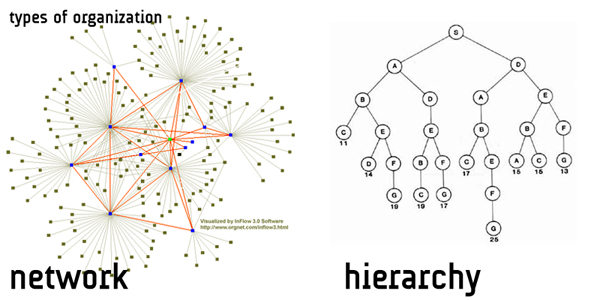
Each node can find each other, be it person, data, server; internal or external to an organization.

Each node can find each other, be it person, data, server; internal or external to an organization.

We now live in a networked age. We are all increasingly interconnected with, by, and through each other and with information that ricochets around us at nearly imperceptible speeds. Hierarchy is giving way to wireachy. A new mental map forms, where people, data, and ideas are all vectors that connect or deflect in reaction to each other. The hierarchy that was so effective in amassing the troops and directing activities is giving way to something quite different.

Once we grok this new geography of the digital age, our anxiety (hopefully) gives way to a world of possibility. “Leaders” (C-levels, principals, independent consultants/contractors) begin to realize that they cannot and should not attempt to oversee actions, and “workers” understand that theirs is not to wait to act on orders but rather to discover, filter, learn, synthesize, and share by what becomes a Personal Knowledge Mastery (PKM) practice . We are level on the flat plane of the network age. (Read a terrific background and personal discovery story of PKM by Harold Jarche.)

Our primary activity is to learn. Whatever our job is today will be different tomorrow. Those who cling to “this is how we do it here” will be increasingly isolated and frustrated. Those who become continuous learners and flexible actors will be in position to thrive.

This new Learning Age perhaps requires not a map at all, but a compass. In a flat landscape without rivers to cross and mountains to climb, we need a direction in which to head and the agency and autonomy to find our own ways. Leaders will still set the necessary vectors and create a compass for all in an organization to follow, but individuals are free to explore, fail, succeed, and learn with shifting collaboration and cooperation as the moment warrants.

Learning professionals have an essential role to play. While a small percentage of people are already setting their compass and navigating the network, most don’t have the mental geography or digital skills to learn, influence, and make sense of the new reality. Learning is not only essential, but so too is learning to learn—and relearn—the recursions of modern digital work. We need to step up and show people how navigate.

Knowledge led people to change from reading the stars for fate to instead use them for navigation. Hmmm … nodes in the network resemble stars in the sky. Yes, recursion.

“Technology” does not have a multitasking problem. Multitasking has a multitasking problem.

20 Feb

Any tool is a weapon — if you hold it right. Ani DiFranco

The problem with our always-on digital world is that everyone is trying to multitask. The less technology you use, the less that will be a problem. Or, so many people will tell you.

Rubbish.

Technology has nothing, or at least very little, to do with it. Don’t blame the sunset for distracting you from your work. Anyone who does good productive, creative, inventive, inspirational work is able to solve this problem. By scientific definition, the executive function to focus on completing a task successfully precludes multitasking (from technology, or any other source). Executive function can only handle one problem at a time. (Oh, but were we wired otherwise!) So, the issue is not multitasking, but distraction.

Those who are easily distracted today by Twitter and Angry Birds and Facebook and Game of War are easily distractible. That is not a technology issue. (I freely admit I am easily distractible, too!) We all had friends in school who would suddenly fall behind the group, having stopped to observe an ant hill or sunlight through leaves or a pretty attraction, some object of desire. Same as it ever was.

What has changed is the manifestation of our distraction, in plain sight for all to see: those darn phones! When I am with my wife at a restaurant, she can (usually!) tell if my mind is off somewhere else, undeterred that she is trying to have a conversation. This is human nature. However, if I am equally (or even less!) distracted by looking at my phone, be it a text message or solitaire, she is all the more annoyed and lets me know in no uncertain terms. I can’t say I blame her—I feel the same way.

So, it is more the case that phones signal to others that we are not on the task we are supposed to be on, be it work or socializing. Ah, but the temptation is always there, that constant siren song of distraction. Can’t that be dumbing us down into mere entertainment consumers when we could have be having deep thoughts? As a recent New York Times op-ed column highlights:

The direst prediction offered by digital critics—our phones are really pocket-size deep fryers for the mind—may be untrue, but the alternative I’ve suggested sounds nearly as bad. The appetite for endless entertainment suggests that worthier activities will be shoved aside. We may buy Salman Rushdie’s book, but we’ll end up sucked in by Flappy Bird.

However, it goes on:

That doesn’t quite seem to be the case, either. Research shows, for example, that the amount of leisure reading hasn’t changed with the advent of the digital age. Before we congratulate ourselves, though, let’s acknowledge that brainier hobbies have never been that popular. There have always been ways to kill time.

And so we arrive at the point of interest. Our devices are not going away, nor all the “unproductive” ways we use them. Their ability to distract us seems limitless.

Woody Guthrie understood that an instrument or tool's power lay in the hands of the user.

Woody Guthrie understood that an instrument or tool’s power lay in the hands of the user.

However, their ability to engage us is equally limitless!

They can take our notes, capture our thoughts, connect to people and ideas, and answer our pressing questions, large and small. As with any tool that we have ever made for ourselves, from the wheel to the PC, it is only as productive as the person using it.

Productivity, creativity and motivation (or lack thereof) remain the essence of human action. I argue that as many people may be turned into entertainment-distraction zombies, an even greater number of us have been hooked into networks, hobbies, niches and communities through digital portals. I can tell you this: The hours I spent in front of the Gilligan’s Island and Hogan’s Heroes when I was a child would have been much better spent on Facebook and Twitter.

As a learning professional, I say rather than battle our little distraction machines, let’s redirect to make them little engagement machines instead. When I plan a learning experience now, I find a way to incorporate mobile devices into the flow of the activity (synchronously or asynchronously). People need to learn how to how to hold it right to make it useful for productive purposes.

Words With Friends will always be there when we need a distraction—but you can’t multitask that game, either.

Networks of Influence: Borderless organizations and Southeast Asian kingdoms

12 Feb

This is what I love about writing in this space!

It allows me to make sense of seemingly unrelated ideas that suddenly burst through, like a magic eye picture. The act of writing helps me form ideas, and the act of sharing helps me find/refer to others that will enhance or redirect those notions. (Sharing publicly is also a lesson in personal bravery for me, telling the world, “This is my idea today, which I concede I may contradict tomorrow.” I like that, too.)

I am finishing up Harold Jarche’s latest book, Finding Perpetual Beta. If you’re interested in organizational growth, knowledge management, technology and change management, I highly recommend that you obtain, read, mark up and share it. One of the ideas that struck me was the importance of exploration at the soft edges of the organization.

In many organizations the outside world is better connected than inside the workplace. This makes it difficult to connect at the boundaries, which is where we have the best opportunities for serendipity and potential innovation.

At the edge of the organization, where there are few rules and everything is a blur… opportunities are found in chaos. In such a changing environment, failure has to be tolerated. Value emerges from forays into the chaos. (pp. 26–7)

This sounded so familiar to me, but it took me a while to place where the same idea applies in a very different context: traditional Southeast Asian kingdoms. Wait, what?!

When I was in graduate school, I studied Southeast Asia and political science. I remember sitting in a class led by the brilliant Al McCoy, as he discussed the structures of authority in traditional kingdoms and sultanates in the islands of what

Borders are hard to draw on waterways. Power was distributed in spheres of influence radiating out from the thrown.

Borders are hard to draw on waterways. Power was distributed in spheres of influence radiating out from the throne.

are now Indonesia, Malaysia, The Philippines, etc. I remember him describing how these were influenced-based networks of rule without formal borders. The king sat on his throne at the divinely placed epicenter of authority, while the edges of his influence—where his network brushed up against others—was where trade, creativity, artistry and knowledge were most active.

As I read Jarche, among others, I see the same things: Organizational walls are becoming porous and unguardable. Hierarchal structures are being transformed into networks and what John Husband has termed wirearchy. I could barely wrap my young mind around the notion of authority without borders and kingdoms without armies to guard them. But great trading post cultures—from Singapore to Samarkand to Timbuktu (to New York?)—grew and their culture thrived precisely because they lay at places where authority dissipated and cultures combined in new ways.

Jarche is quite right to say that there is nothing natural or traditional about hierarchy as an organizing principle. It emerged with modern military and manufacturing. As the social learning age replaces command-and-control, and the notion of the loyal “company man” disappears, organizations and individuals that thrive will develop new ways to find and create value.

As Joi Ito rightly points out, we now inhabit a chaotic, democratic, crowd-sourced world. Finding new ways to develop PKM and ongoing organizational adaptations (“perpetual beta”) are the ways forward.

Why tweet, and who gives a hoot? What Twitter does for me

30 Jan

I read, write and think about learning, knowledge management and collaborative work — it’s a lot to keep up with.

My Personal Learning Network (PLN) and Personal Knowledge Management/Mastery (PKM) practice has become vital to my professional growth . Of all the things I do in support of these efforts — blog, write articles, read, synthesize (what PKM calls “sense-making”), share, meet, respond and react — it is Twitter that I get the most questions, doubt, and even hostility about.

I want to share here why I use Twitter, and how it helps me.

I begin by saying I was late to it. I was skeptical, and more than a little derisive about those tweeters constantly tethered to their phones. I did not dive in: I was hesitant, lurking, dipping my toes in one digit at time. So, to you doubters, I was there with you not long ago.

Now, in two-years’ time, I can’t imagine my professional life without it!

With that said, it is NOT about Twitter itself. Twitter is a tool, like a hammer or a saw — they are useless until used purposefully. Twitter will be gone in 5 (or 10?) years, replaced by something(s) else. While I have found great value in applying Twitter to develop my PLN, it needn’t have been Twitter. It just worked well for me. You might find another tool that works for you. Great! It is the practice, not the tool.

Some ways I use Twitter to propel “real” work:

  • Capture thoughts and notes in real time, often with a hashtag (#, as in #learning) to help categorize it for myself and others.
  • Share and “favorite” useful tweets to let the most pertinent comments rise to the top and become easy to find.
  • Find like-minded people across the hall, or across the globe, with whom to share and learn. I have built my PLN from scratch, relying on Twitter for 90% of it. There is generally a true spirit of generosity and openness that’s remarkable.
  • Follow and learn from experts and leaders, to see what they are thinking, reading and see who they are following. Because Twitter is a-symmetrical (unlike Facebook, for example) you can follow anyone without the need for that person to reciprocate. (This difference was articulated nicely by Harold Jarche, which — and whom — I found via Twitter.) I follow @BarackObama, but he doesn’t follow me… yet!
  • Twitter storms. A synchronous (live) twitter event around a particular topic, these are generally moderated in a Q/A format with some opportunity for intros and self-promotions. Twitter storms are extremely useful to share and hear ideas, “meet” new like-minded people, and enjoy some PD time. Best of all, the transcripts are available after to remember and reflect on the storm’s activity.
  • Like Twitter storms, tweeting during — yes during! — live events, classes and sessions proves to be very useful. It creates a “back-channel” to help make sense of the information, and adds instant and long-lasting value by providing insights into what others make of it. In addition, it is a great way for me to experience an event even if I’m not there. It is so valuable!

The most common reservations I hear:

Who cares what I think? I care what I think (or thought last week or last year). You also might. And if not, that’s fine too. It is a micro-blog tool, a way to share thoughts and activities. The value is in the stream to reflect upon later, to discover others who cared, reactions to forming ideas and activities as they grow. When you share an idea or thought, you never know how others — or even you, after some time passes — will react. I saw Dr. deGrasse-Tyson stop, mid-talk, to tweet a thought. If it is worth noting, it’s worth saving. And, if worth saving, it’s worth sharing.

What can you learn from 140 characters? It’s not enough! Enough for what? To jot a note? Or ask a colleague a question? Or refer your friend to an article or video you found? 140 characters is plenty. In fact, I have found over time that the space limit actually helps sharpen my writing — and thoughts — down to essentials. Remember: It is not a replacement for other forms of communication!

It’s a fad that’s going away. As I say above, it’s true: If we’re still using Twitter 10 years from now, I’ll be quite surprised. The same is also true of Facebook, email (please, let it be so!!), and wired telephones (who has long phone conversations anymore!?). Tools come and go, but building PLN and PKM practice will remain.

It’s too informal. It’s frivolous. Depends on who’s wielding the tool. It can be feathery light or as serious as life-and-death (literally, as #BlackLivesMatter showed).

– I don’t have time. If you find it useful, you’ll have time. You don’t have time to change a tire on your car on your way to work, unless you need to change the tire.

Find me @BenCpdx… I’ll leave the bird on for you. If I’m the recipient of your first tweet, it would be an honor and I promise to reply.

bdc twitter

Stuck inside of mobile with the platform blues again

22 Jan

I hear it everywhere I go, in conversations with people who don’t know better and—more frustratingly—with people who should. Some variation of the themes laid down in this recent article from CMS Wire. Complete with a fine-looking infographic (which I’m a sucker for!), the author highlights trends in business communication. She points out the shift to a higher share of communications on mobile devices and internal tools (intranets and enterprise network solutions (ENS)), and away from face-to-face meetings.

She is correct on each point, and yet misses the point entirely.

The significant trends in our networked world aren’t about mobile, communication platforms and new devices. The “trends” in workplace communication are about why and how, not what and on which platform.

As I’ve discussed in this blog before, alongside and in the footsteps of those more expert than I, all that devices and platforms provide us with is a new gateway to discover, categorize, tag, share, synthesize and learn from the information at our fingertips. The hot new device of 2015, and whatever new platform your organization rolls out this year, doesn’t really matter. Devices and platforms are fleeting and will be gone by 2020.

The mental maps we create are the critical element in how we work/ learn.

The mental maps we create are the critical element in how we work/ learn.

The real change is between our ears, within organizations that are reconfiguring away from hierarchies and toward network-centered activities, and those who can learn—and make use of that learning—every day, individually and collectively.

I see this confusion raging even close to home in my own PLN in eLearning and L & D circles. “Mobile is the next big thing!” No, it isn’t. Mobile devices are becoming ubiquitous and we can’t ignore their significance in how we deliver learning experiences and performance support, but they are only a facet of what really is the next big thing: personal learning and how it intersects organizational and communal learning. The significance of “mobile vs. other” will be over by 2020 (along with email as primary work function, please!!), but the significance of learning practice as the tool for organizational and professional development is just getting off the ground.

Sooner or later, one of must know… sorry, couldn’t stop myself.

Thanks, Bob.

Thanks, Bob.