Archive | informal learning RSS feed for this section

Abundance and Choices: Make the decision and move on

22 Apr

We know the feeling: Standing in the cereal aisle, or before the maddeningly long rack of cold medicines, frozen by the overwhelming number of choices. Can’t there be just three choices? Fiber-filled, healthy, or frosted. Good, better, best. Too much really is too much!

I was asked to talk recently about Personal Knowledge Mastery (PKM) practice, curation and the ability to sort through the overwhelming amount of content that streams at us constantly. One sincere listener mentioned that while he spends time and energy clipping useful articles and organizing content into folders, he knows he’ll never have time to go back and examine all the saved content and sort through it all to find the nuggets of potentially useful ideas.

My response to him was that it doesn’t matter. The room fell silent (as I hoped) and opened the door to explain in further detail. (Side note: If you ever want to get a room of serious-mined people to pay attention to a particular point, set it up with “What you do doesn’t matter,” or “What you know is not important.” Provocative, and engaging!)

In the digital age, the social age, or what I call The Learning Age, what you save in a file somewhere really doesn’t matter. Saving clippings in a file folder or, more recently, on a digital drive somewhere, is a bygone mindset for a world in which content was scarce and locating something on a particular subject was difficult and time-consuming.

We now live in an age of abundance and constant choice. It’s all available at our fingertips, and anyone with even the most basic digital literacy skills can find just about anything. As an example, I had foot surgery last year: Not only could I look up my diagnosis, I watched videos, in fascination and horror, of the actual surgical procedures. Bone saws and drills. NOT recommended!

The critical practice of our age is not finding and saving content, it’s curating, sense-making and sharing. That is, it’s a new practice.

Step 1. Make a decision. Act. Looking for something on topic “X” gets 500 results. There is no way you’ll ever know which few will make the most sense or prove to be the most immediately useful to you. Skim and choose one (or two or three). The decision is the first step of the practice. There is no right or wrong decision, only the act (with apologies to Yoda). Also, note how you made the decision – the reasons, the decision-making criteria – so that it also becomes part of the practice.

Step 2. As you read (or watch, or listen), note how it relates to what you already know, or do, or think. Even if you don’t find the immediate use that you may had originally hoped, relate it to other thoughts and ideas. (If you can’t, toss it.) Content is relational and contextual, and how your mind makes those connections is critical to PKM practice. “This relates to that, reminds me of this, and here’s why.” Putting new information into context: That’s learning. Be creative, metaphorical, and experimental. Tag it with whatever taxonomy terms makes sense at the time (it may change later – don’t be rigid).

Step 3: Share it, and by “it” I mean the content, your notes on the context, and the tags: All of it! Make it visible to you (later) and to others in your organization and your Personal Learning Network (PLN). Rely on social media (Twitter, Facebook, LinkedIn, etc.) and curation tools (Scoop.it, Feedly, Storify, Evernote, Delicious, etc.) to share it with whomever will find it. The technology you use is unimportant. The practice is the key. (I happen to like scoop.it because it’s easy to write your notes with each share, and invite others to do the same. Use what you like and what works for you.)

Step 4: Let the network do the work. Once you begin to form your own Personal Learning Network (PLN) through social media and in-person connections, they will share with you, comment on your shares and patterns will emerge. You’ll find those people whose content you trust, and in turn connect with who they trust. You will increasingly find relevant content—because you are getting better at contextualizing and sense-making – making Step 1 less and less necessary. You’ll find that the content you find through your PLN comes preloaded with contextual relevance because it is from/through the network you are building: Your own network of people, ideas and applications.

Step 5: Practice. It’s a practice, so, you know, practice! This is not a just-in-time activity to do at the moment of need. In order to build your sense-making capabilities, this becomes a part of the way you work. It requires pruning, nurturing, adding and subtracting. Your PLN and the ways you make sense of ideas will shift over time. That’s learning! Don’t be rigid: Learn to trust the system you’ve created.
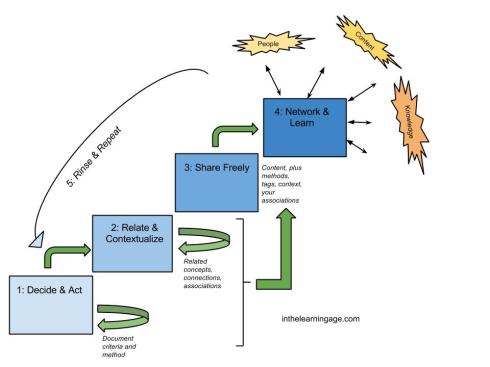
Ben's PKM ProcessIn the end, the important thing is making the initial decision, learning what you can from it and moving forward. If you’re like me, you’ll find yourself relating back to a few core ideas time and again, anchoring learning in principles and allowing for deep exploration without completely losing your bearings.

Happy exploring! (Oh, and choose the healthy cereal, except on your birthday. Then, frosted all the way!)

It’s Our Move: All learning is akin to chess learning

16 Apr

Chess is a game of constant striving, where even the greatest mastery is put to the test in search of constant improvement. Shouldn’t workplace learning be the same?

If you are even a rudimentary chess player, I expect that this analogy will ring true. But even if you have never played chess, the idea of laying out vision, goal, purpose and context in which learners can apply their nascent skills is a critical component to any complex/compound learning design.

Vision

The learning game, be it chess, sales or facilitation skills, begins with a vision. If the learner can understand where their newly acquired skills will take them, they (hopefully) will develop the tenacity and trust to stick with the rudimentary practice that forms the framework for skill development.

In chess, that begins with the end. That seems an obvious statement, but I have often observed that people want to begin by explaining the pieces: The King, the Rook, the Bishop and Pawn. But those are abstractions to the novice, only meaningful as tactics and strategy is formed as part of understanding the game. Instead, start with the end vision: Check mate!

Starting Point: This picture has no relation to actual chess play, but it drives across the vision -- trap the other king.

Starting Point: This picture has no relation to actual chess play, but it drives across the vision — trap the other king.

Goal
Once learners have a vision of the game, next move on to the goal of chess (no, not how the horsey moves – not yet!), which is to move your pieces around in order to achieve the vision. An explanation of capture-and-removal can be introduced here, but only as an idea, not as a tactic (yet). Have the learners move the players—with no regard to actual game play or rules—so that they achieve check mate. That’s the goal: Trap your opponent’s king into an immobile position.

Purpose

Enter your opponent! Now the purpose of game play, of each move begins to take shape. Purpose translates into action in a way that goals and vision do not. Not only are you out to contain your opponent’s king, she means to contain yours, too: Offense and defense. Now the ways in which the pieces move, and how to strategically deploy them, how to occupy space on the board, and how to string strategy into tactics, begins to make sense. The purpose is to win the game by out-planning and out-executing the forces that align against your success (your opponent).

Context

With a grasp of purpose, each move is seen in the context of the whole, a stage in the game, the situation of each player now as a result of actions taken (or not). This is where skills are built, and learning becomes knowledge. Theoretical principles (goals and vision) are put to the test, and failure leads to success, leading to deepening understanding.

This (idealized) real version of checkmate only makes sense once you can identify the pieces and understand their properties.

This (idealized) real version of checkmate only makes sense once you can identify the pieces and understand their properties.

Practice

Play becomes practice, practice play. The only “real” way to learn something on a deep level is to make your own mistakes, learn from them, all the while building up your ability to apply purpose and context to the ever-changing conditions. Practice allows learners to demonstrate progressive skill acquisition and to show evidence of deepening understanding. Visibility, transparency, narration and inquiry are key to good practice. And all play is practice – the learning never stops!

Vision

Goal

Purpose

Context

Practice

Imprison opponent’s king Place your pieces into position on the board to capture the king Capture the opponent’s king while defending your king from capture. Make good incremental decisions to achieve goal. Your pieces have different properties, and you use those properties to defend and create an offensive strategy to advance your purpose. Think strategically at every decision point, align actions to goals, purpose and current context, iterate, experiment, fail, and succeed: In other words, learn!

So, starting with the end in mind: Do you allow your learners to demonstrate, narrate and explicate their actions in a supportive, non-judgmental learning environment? If not, how can you measure what they’ve learned? That’s the foundation on which everything else is built. Practice never makes perfect, but ongoing improvement is only achieved through ongoing visible practice.

I have an Idea: Now what?

31 Mar

The older I become and experience I gain, the more interesting ideas I find and (sometimes) generate. Some are silly, some (I think) are quite insightful, and other need time to marinate in the juices of other ideas and experience to even make sense.

Some ideas are immediately applicable, while others remain theoretical. Some never make it past mindful amusement, while others change personal and professional practice in meaningful and lasting ways. But even the most ethereal add value by constantly shifting the filter mechanisms through which new ideas and experiences are sorted.

I’m not exceptional in any way in this regard – pretty much everyone has ideas all the time that amuse, fascinate, and distract. I have created my own system that has been working (for me) for keeping and weighing ideas over the last several years, and it folds in nicely with the more general connectivist mindset that resonate with me. At the heart of connectivism is the idea of relativity: Ideas, knowledge, experience and actions are not absolute, but are constantly measured against past and freshly-acquired content/context. That is, we are in a constant state of recalibrating and re-measuring what we know, what we do, and what we think.

I am not a good self-organizer, and never have been. Attention to detail is not my strong suit. But, I’ve learned how to incorporate a systematic process – a PKM practice, I suppose – that works for me. Being naturally disorganized and messy, it would be a stretch to recommend what works for me to

My Scoop.It page is one place to collect and reflect on ideas.

My Scoop.IT page is one place to collect and reflect on ideas.

anyone else.

I believe the key, though, is to have a system – any system that works – and practice it faithfully. What’s more, when we capture those ideas digitally, via Evernonote file, audio “notes-to-self”, curated boards (like Pinterest or Scoop.It), Twitter favs and retweets, and so on, it becomes easy to tag, retrieve and connect. I shuffle ideas into connections via visual mind maps, with arrows, dotted lines and color codes. About once a month I do a formal iteration break, with the archives becoming a record of my idea evolution.

One other great benefit of that process is it is easily shared, too. As we are discovering, the Work Out Loud (and their corollaries Think Out Loud and Learn Out Loud) practice is a centerpiece of both personal and organizational growth.

Whatever your practice is or becomes, it is learned and constantly refined. Don’t assume that others have the skills to do this on their own. I learned from others, and I try to share with others the purpose and benefits of thinking and working in this way.

Sense-making In The Learning Age is an ongoing process, and I welcome hearing from you about how you make it work.

Riding the Digital Stream

23 Mar

Proud to be part of the Learning Solutions Magazine community! See my article, just published there today: Riding the Digital Stream: Integrating Modern Learning Practice into Formal Programs

LS Mag Front

Eat the cookie dough! Half-baked ideas are welcome.

17 Mar

My friend David and I took an epic road trip many years ago, the kind that can only be made by the young and foolish: Chicago to New York to surprise a friend. With no more than $20 in our pockets and his grandfather’s gas card to cover expenses, we set out to the east with the sun at our backs. Oh, to be 19 again.

Food? We had the gas card. Hotels? I don’t think it ever occurred to us. It was only a 12-hour drive, after all. At a truck stop convenience store around South Bend, Indiana, we gassed up the tank and stocked up on provisions. Jerky. Chips. Water. Nuts. And, as a last impulse that can only be ascribed to … could there be an adequate explanation? … a roll of bake-at-home cookie dough.

The Ohio & Penn Turnpikes, a roll of cookie dough, and the night. What could go wrong.

The Ohio & Penn Turnpikes, a roll of cookie dough, and the night. What could go wrong?

Raw cookie dough. Delicious, filling and funny—it seemed like a great idea. Bake, schmake! So as we drove we passed the plastic tube to take bites of dough. By the time we hit Youngstown, Ohio, neither of us felt so well. By the State College, Pennsylvania, cutoff, our bellies were aching like we had eaten billiard balls. Now I realize there was a lesson for today.

With the memory of that gut pain as my guide, I say we need to find a new place to share half-baked ideas and raw notions. In the spirit of show your work and working out loud (#WOL), we need a renewed sense that there is value in sharing the half-baked, ill-formed and in-progress stages of our work.

Just as luck finds those who prepare, serendipity of ideas and connectcookie doughing disparate dots into new insights come to those who are willing to share not only products but process; not only results but notions, hunches and hypotheses.

The reason why many “digital age” companies try so hard to create open spaces for folks to bump into each other—think Google’s cafeteria, Nike’s athletic facilities, cubeless open workstations and Yahoo!’s effort to curb its remote workforce—is to create the conditions for serendipity to occur.

Even when we are not actively collaborating with each other, we should certainly be cooperating with each other, dovetailing our efforts and forming brief spats of collaboration toward the same goals.

Short of the Google cafeteria (or, in addition to it), what this calls for is a more transparent, open spirit of sharing and learning. When you wait until your work is fully baked, with all the icing applied, you’ve waited too long. The learning, the idea development, the benefit to others from your work are revealed in your process, not your product. Mistakes and wrong paths are the quintessential learning moments.

Don’t wait to share your plate of beautiful cookies. Show us your ingredients—how you crack the eggs, the messes on the counter, why you chose your bowl and tools—and let us decide what to do with the dough. Some of us will bake it; others prefer it raw. That’s where the learning happens.
#WOL #LOL #ShowYourWork