Archive | technology RSS feed for this section

It’s a matter of words

28 Mar

What’s in a word? Well, quite a lot it seems. Recently, in both my personal contemplation and my professional discussions, I have been grappling with what to call this thing that we do. We are e-learning practitioners and we have an e-learning team. That is how we refer to ourselves and how our organization refers to us. That’s (mostly) fine for our internal reference, but it becomes problematic in a larger context.

Let’s try on some other words to see how they all fit:

"E-learning!?  You keep using that word. I do not think it means what you think it means."

“E-learning!? You keep using that word. I do not think it means what you think it means.”

E-learning: Setting aside the lack of standardized spelling (eLearning, Elearning, elearning, e-learning, E-Learning, etc.), what does e-learning mean? Per my previous posts, in a world where we are compelled to be life-long learners or risk “falling behind,” and in which we spend considerable hours in front of screens of all sizes, what is the “e”? Yes, we learn in many ways, but for many e-learning is an opaque, esoteric term. For others, it immediately conjures the dreaded “module” — pages of texts to click through and perhaps take a quiz at the end. Not exactly what I’d like to be associated with.

I know E-learning has stood the test of time: The eLearning Guild (in which I am an active participant), ASTD e-learning certificate, the great E-Learning and the Science of Instruction, and so on. But then again, times they are a-changing (and always will be). When someone comes down my hall to tell me that they need one of those e-learning things, somehow I feel that the term has failed to have our intended meaning.

Distance Learning: “Back in my day, we took a distance correspondence course to become a radio repairman. Then we were set for life!” OK, maybe that is a bit unfair to that term and those who use it. But, I also don’t think it comes close to describing what we do. Certainly a person in an organization can be learning while sitting next to another person who is learning and across from the instructional designer who created it. Distance is neither a defining condition nor a very apt explanation, any more than reading is a form of “distance communication.”

Virtual Learning: I admit this one really boils my butter. When I’m watching a show about the platypus, I’m learning. When I’m taking a course on the latest computer system, I’m learning. And, when I’m making connections between my colleague’s Twitter feed and the latest industry trends, I’m absolutely learning. None of it is virtual – it is all real! As real as 8th grade math class was (which was virtually useless, I concede). Learning is learning, no matter the media. So, until I put on the high-tech goggles and start learning to slay dragons, let’s put this one away.

Digital Learning: Hmmm.. this has potential. Yes, what I do is design learning programs that are (mostly, anyway) delivered through digital media: some combination of sites, courses, videos, webinars, online affinity groups and communities of practice, curated websites and content streams, etc. Would the larger world read digital learning to mean learning about digital technology? That is a potential problem, but it may not be insurmountable.

Holistic Learning: OK, I’ll put on the Enya and you get the crystals. Shame, because I think some word that implies a comprehensive program of adult learning, one that encompasses courses, social learning, performance support,

 From enya.com

Enya wants in on our holistic learning. enya.com

professional development paths, etc., is a worthy endeavor. But I don’t think I could pull off calling what I do “holistic learning” – and I know my colleagues couldn’t. (Joking, dear friends! Sort of.)

Performance Support Programs: I do like the idea of leading with the purpose (performance support) rather than the delivery vehicle (courses, job aides, websites, webinars, etc.). After all, that is the purpose we undertake any adult learning program, isn’t it? For learners to apply what they know and what the learn in order to perform better. A bit more closely aligned with HR-speak than I might care for, but it’s not bad.

I have a close colleague here, though, who strongly objects to the term “perform” as it applies to people and their jobs. Actors perform. Trained animals perform. But free-thinking people have self-determination and agency beyond mere performance. While I don’t have that reaction, there seems to be enough folks out there who do to consider carefully how and where we use this term.

Online Learning: Online, that is connected to, well, something: The Internet, the web, the LMS, the satellite, the cell phone tower, the intranet. Even if we are still working in CD- or DVD-ROM-based training (it’s 1998 calling: It wants it’s CD back!), the notion that we are using a connected tool (the PC) on which to learn seems pretty solid. And, it sets personal or classroom learning settings as something apart from online learning. Do we have a winner?

Can we swap “online learning” for “e-learning” as the more succinct, less negatively connotative term? Perhaps I’ll take it up at the next eLearning Guild event.

I would love for your thoughts on this. Feel free to leave a comment.
Webbie Winners: Are IDs and e-learning folks keeping up?

4 Mar
lifesaver uk

From life-saver.org.uk — an amazing interactive learning video. It takes a while to load, though.

I had the good fortune to squeeze out 45 minutes to breeze over the latest Webbie Award 2013 winners. It was not nearly enough. However, as is my habit, I diligently clipped the winners or nominees that drew my eye to something that might be applicable to e-learning and learner engagement. This is a great example of how and why I am so enthusiastic about PKM (Personal Knowledge Management). But that is a topic for another day.

So, what can e-learning practitioners glean from Webbie winners?

Trends:

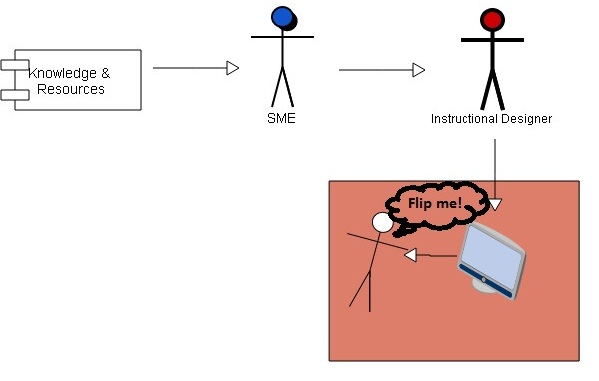
Flipped classroom and Instructional Design: Flip me!

19 Jul

My workplace’s primary historical purpose was to improve, support, and supplement classroom teaching. And while Education Northwest’s scope has expanded over the years, there are thankfully still many very smart people steeped in the world of education and scholastic excellence.

I am not one of them.

My background, as you know if you’ve read this blog before, is in Instructional Design (ID) and e-learning, especially for adult workers (i.e., training). This is both a challenge and opportunity. On a day-to-day level, it means learning each other’s terms, nomenclature, and assumptions, so we are speaking a common language when we talk about projects and solutions.

A colleague recently pointed to th

Interaction is essential for class room learning.

Interaction is essential for class room learning.

e (terrific) trend toward “flipped” classrooms, where teachers spend most of the class time coaching hands-on activities while allowing students to watch the “lecture” online, suggesting that this was a step closer to what I do. Yes, a challenge and an opportunity.

While watching lectures, TED talks, videos, and other infotainment is all well and good, it is in fact not what we IDs and e-learning designers do. When instructors or trainers stand in front of learners, whether to lecture or to train, they have an immediate feedback loop: The learners are engaged, bored, eager, confused, frustrated, etc. Through conversation, application, and exercises, the instructor has an immediate way to judge success and failure. It is a true two-way give-and-take, and good trainers (and teachers) thrive in that environment.

When we think about e-learning, we start with the learner—alone, at a screen, hoping at best to have a useful and mildly engaging 15 minutes, but fearing pages of text that bore him to tears and from which he will retain next to nothing. (Well, there’s always email, solitaire or less wholesome ways to pass the time if forced to sit at a screen.)

An ID’s job is to design something to surprise, delight, and exceed those dreary expectations.

IDs think about the lonely learner: "How can I reach these kids?"

IDs think about the lonely learner: “How can I reach these kids (or adults)?”

How can we replace that human classroom experience with a learning experience that engages learners and, in its most elevated form, allows them to transfer the knowledge and skills to their work performance? That is our starting point. Creating that design is part science and part art. It requires a deep understanding of the topic, and then combines it with the science of how people learn, how they might apply what they’ve learned to real life, and what kind of activities convert a screen watcher into an immersive participant in his own learning. That’s what e-learning specialists do.

Anyone with modest proficiency can tape a lecture or throw slide sets online and call it learning. At best, it’s an interesting invitation that might lead to learning: The flip in the flipped classroom is where the magic happens. E-learning delivers the flip, not (just) the lecture.

Collaboration as Learning? Collaboration IS Learning (or certainly should be!)

9 Jul

I’ve discussed in earlier posts my strong belief that learning is based in discourse. Through conversation, examination, doubt and reaffirmation we arrive to that place where we are confident in our understanding, our knowledge that we’ve learned something significant. Even if it is internal dialog, there is no substitute for point – counter-point.

It seems like a logical extension then, that the waves of tools, systems and organizational necessities to make collaboration more effective would take us a good distance towards learning workers and learning organizations.  But, for many of us, that has been far from the case.

The more often I speak into a triangular phone, the more I stare at the moving mouse of a screencast or web meeting, the less I feel like I am collaborating (or learning!). Why? Peter Senge, the godfather of learning organizations, had an interesting post the other day about this very topic. Real Collaboration Takes More than Meetings and PowerPoints dives into the heart of this conundrum.

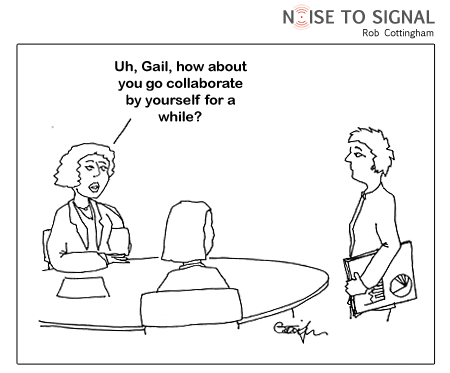
The main takeaway of his post is that collaboration takes deliberate effort, and a workplace culture that demands it. Collaboration should not be, in fact cannot be, passive.

Rob Cottingham, via timesunion.com

Rob Cottingham, via timesunion.com

Collaboration is an act, a participation in a conversation that, if well-managed, drives to reveal facts and decision points. As Senge points out in one good example,

Practices for fostering thinking together need to be embedded in meetings as well. Whenever any of these networks meet, there are few “PowerPoint shows.” The vast majority of the time is spent in small working sessions and larger plenary dialogues….

Yes, our old friend dialog. It what makes the first Star Wars movie so much better than all the rest.

Hmmmm…. Active, engaged, participatory, the very opposite of passivity: Gosh, that sounds a lot like what trainers and Instructional Designers say all the time! Right, collaboration is learning when done well. If you have nothing to learn, and nothing to share, then why collaborate at all? The key is to manage the time, tools and cultural expectations to allow learning to happen.

Creative Commons and Discovery Learning

10 Apr

I’m not a graphic designer. I’m a very amateur photographer, and a mostly-non-recording Imagemusician. So, I’ve had little reason to pay very close attention to the Creative Commons movement, and how it is changing the way creators and consumers of digital media interact.

But with a little help from articles like this, I’m realizing more and more that how we share, use, re-share and reference resources that are readily available and a mere click away has a lot to do with the way we learn today. And even more about what ways in which we’ll be learning in a very close-at-hand tomorrow.

It references back to ideas about learners as their own curators and creators instantly enhance learning. For adult learning and professional development, it will be interesting to see the ways this intersects with the move towards “big data” and the movement towards available data crunching and graphic display technology that has been the buzz in the business world recently.