Archive | social learning RSS feed for this section

Book Club Readings: Learning and Development in our Connected, Online and Social Workplace

18 Jun

I was asked to provide readings for Education Northwest’s book club this month, and to moderate a discussion. The whole process was fun, interesting and revealing. I thought I’d share our reading list here, along with my notes of talking points on each.

Joseph Stiglitz: Creating a Learning Society

Clark Quinn: Revolutionize Learning & Development: Performance and Innovation Strategy for the Information Age, chapters 5 (“Our Organizations”) and 6 (“Our Technology”).

Harold Jarche: Organizational Learning in the Network Era (blog post, 29 May 2014)

Jane Hart: 4 Models of Social Workplace Learning (blog post, 12 June 2014)

Jane Bozarth: Show Your Work: The Payoffs of Working Out Loud, chapter 4 (What is Knowledge? And Why Do People Share it?)

Talking Points for Book Club:

  • Heady times to be in organizational learning and online knowledge
  • Confluence of organizational theory and tech tools
  • A line from global-economic to very personal: Learning is the issue of our time (society, organization, personal)
  • Learning is NOT separate from working: learning is process, practice
  • It’s hard to share (articulate) what you know
  • Structural barriers we may not even be aware of block learning
  • All knowledge is personal; all learning is social

Stiglitz:

If incremental changes impact societal development, learning drives the increments. How do we promote learning in our society? NOT scholastic learning, or formal learning, but culturally adaptive and learning.

Intellectual property can block societal learning because it prevents the free flow of information. Innovation is reduced. Owning vs. Sharing economy.

Impeding learning can lead to lower standards of living.

Quinn:

Premise: Organizations need to be constantly adaptive – never in state but constantly changing, growing.

Clark Quinn's great new book.

Clark Quinn’s great new book.

People need the power to pursue their hunches, expand their roles, self-improve: Remove structural barriers.

Social networks to collaborate, cooperate and both –> coherent organization.

PKM and KM : It’s a practice! (Personal Knowledge Mastery and Knowledge Management)

Traditional organizations have hierarchical information & HR structures which are barriers to being a learning organization.

Three keys to a learning Organization (fig. 5.2)

  1. Supportive Learning Environment
  2. Concrete Learning Processes and Practices
  3. Leadership that Reinforces Learning

Technology is evolving through use, not through technological innovation itself.

Having separate platforms for formal learning and social learning is a false divide. (top of page 60)

Jarche:

Structural impediments to learning must be removed.

Interesting tension: Global, connected, mobile vs. local, personal, contractual.

The only knowledge we can truly manage is my own. How do I feed my knowledge to the organization? And how does the organization nourish me?

Bozarth:

We are terrible at telling people what we know: Hard to articulate, quantify.

Some hoard knowledge because it is the only thing they own: Afraid for their jobs, other’s judgments, lack of professional freedom.

Share is the new save! Work out loud.

Hart:

Social learning needs facilitation, and framework. There are different types of social learning and each needs a slightly different type of hands-on experience.

Learning Is Our Job… it’s not just me (or us).

11 Jun

I received a tweet from a friend who happened to be attending DrupalCon in Austin last week. He referred to a remark by a keynote speaker:

jones tweet

You can see my response to the original message above (with poor syntax– but is it grammatically incorrect?).

I was truly heartened to see that the constantly-learning ethos is becoming a mantra beyond the domain of PD/L&D/ID/ELP/SPOTDA* folks. As I’ve argued before in several places, our jobs are to keep learning. Very few of us have a job or career that spans more than a few years at a time. Even if we stay with the same organization, whatever our job is today will very likely not be what our job is two years from now, at least the tools, methods and systems we operate under. (And if it is, ask yourself, “Why!?”)

No, our careers are now tied to learning. And learning is not a solitary endeavor. We learn only in so far as we can seek, catalog, retrieve and share new facts, ideas and methods. That’s where I see us PD/L&D/ID/ELP/SPOTDA* folks gaining in relevance. Most of us are at a loss on how to take that learning management, or Personal Knowledge Management (PKM, in the parlance of our day) from a chaotic hit-or-miss activity to a systematic practice. Nobody taught us how to learn in the digital age, but it is an – the – essential challenge of our careers.

………………………..

PD – Professional Development

L&D – Learning and Development

ID – Instructional Design

ELP – E-learning Practitioners

SPOTDA – Smart People of the Digital Age

Learning Experience: There is no end.

29 May

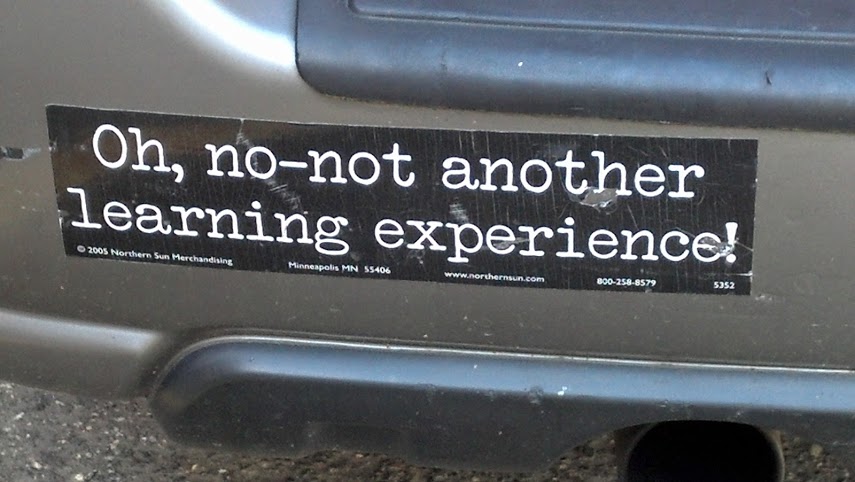
I came across this funny bumper sticker the other day. And while I’m quite certain neither the creator nor the car owner had adult learning practice in mind, it is apt. Learning happens, every day, all day, with or without us.

learning exp

When our jobs were mostly process- and product-based—manufacturing, service, design—ongoing professional and personal learning may not have been as important. There was a time when you could practice your job, advance your career and even feel satisfied without contemplating the ways in which learning impacted your development. That time rests in the dustbin of history, at least for those of us who are “information,” “knowledge,” or “learning” workers.

We are constantly learning now, so the questions for us in the adult learning game are

  • How are people learning?
  • How do we guide people to learn what we want/avoid what we don’t want them to learn?
  • How do we facilitate ongoing learning?
  • How do we know if and how learning is applied to jobs and innovation?
  • Where does traditional, formal learning (live training, e-learning, blended, etc.) fit in?

The only thing we can say with any certainty is that for most of us, whatever our job is today won’t be our job five years from now. Our career is learning, learning is our career: The better we adapt to that reality the better we’ll be. I say, bring on the learning experiences!

Learning in a Connected Workplace: But connected to what, exactly?

5 May

Workplace learning. If your mind fills with images of shuffling off to a conference room to “do the training,” you share the attitude of a large share of learners, I’m afraid. Luckily for us, we’re e-learning folks, so we know better. Learners don’t have to shuffle anywhere anymore. They can “do the training” right at their desk.

Sigh.

If we are satisfied with delivering e-learning courses, 2004 called and wants it’s training program back. If we rely solely on delivered courses, we are losing ground and selling our learners, organizations, and ourselves short. E-learning is great (or should be), and it’s not going anywhere. However, we have to think beyond e-learning development to become true instructional design and adult learning facilitators. You know all too well the two major shifts of the last decade:

  • Information now streams at your learners’ fingertips, constantly on and maddeningly (and wonderfully) distracting.
  • Work is no longer only task-driven, but also learning- and innovation-driven.

That software training you’re working on? Or leadership training? Sales training? Compliance training? You-name-it training? Someone else has already created it, probably better, whether it’s off the shelf or up on Lynda.com. Not only that, there are Twitter hashtags and Facebook threads and meme jokes and outright snarkiness out there about your very topic. And here’s the irony: You want the kind of learners who will find it! They are engaged and curious, and they have at least enough initiative to forward a funny poster. The capacity for nearly anyone to find information on nearly anything is inspiring and horrifying. Our job as learning professionals is to help people harness the flow, teaching them how to evaluate, store, share, and use what they find.

Which leads to the second point: Learning is not a separate part of the calendar, or even a set-aside part of the day.

LEAP Ahead Conference: Portland, Ore., June 25-26

LEAP Ahead Conference: Portland, Ore., June 25-26

Modern working is learning. The latest headlines, industry trends, job tools, and data points are essential to helping workers succeed in almost any industry. We’re all knowledge workers now, and to be a knowledge worker is to be a constantly learning worker. If we fail to learn and convert that learning into innovation, not just as an organization but as individuals, we’re being left behind by those who do.

The same is all too true for those of us in the e-learning game. What have we been learning? What innovations are we implementing? And how are we sharing it? Let’s find out! Join me as we dive into this topic at LEAP Ahead in Portland next month.

Lessons Learned: Getting the most of e-learning

22 Apr

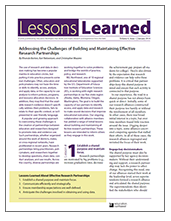
Just a brief post today to share a paper that my colleague, Nancy Henry, and I have been working on and is now available.

Lessons LearnedA lot of the content from this Lessons Learned whitepaper has been included in previous posts, so if you are a careful reader you’ll see some overlap. That should come as no surprise — these are the very subjects I think about in my work (and sometimes in my dreams) every day.

http://educationnorthwest.org/news/3623

As always, I would be happy to hear your thoughts and critiques.