Archive | outcomes RSS feed for this section

Lessons Learned: Getting the most of e-learning

22 Apr

Just a brief post today to share a paper that my colleague, Nancy Henry, and I have been working on and is now available.

Lessons LearnedA lot of the content from this Lessons Learned whitepaper has been included in previous posts, so if you are a careful reader you’ll see some overlap. That should come as no surprise — these are the very subjects I think about in my work (and sometimes in my dreams) every day.

http://educationnorthwest.org/news/3623

As always, I would be happy to hear your thoughts and critiques.

Learn to Teach, Teach to Learn

21 Mar

Imagine this: Learners need to learn to run data, analyze the numbers, and report the findings in a coherent, consistent way. (It could just as easily be “operate a software system” or “build community outreach programs”… it doesn’t really matter.) There are 20 of them. Plus, they have very limited time to meet and are geographically disperse. Go!

What to do, Ms. Instructional Designer? Mr. E-Learning Practitioner?

One approach is to allow the learners to become the expert trainers, and have them teach each other. Who doesn’t recall the details of a topic they’ve had to teach? Want to learn to play chess better? Teach a lesser player to play better, and your game will improve, too.

So, in our hypothetical example, you could divide the learners roughly into thirds (7-7-6), and charge them with becoming an expert on one of the three essential training content areas (collect, analyze, and report). If each team can collaborate, all the better. If not, individual effort is fine, too.

Then, when you do have your precious opportunity to gather in person (live or online), each person/group takes their turn as expert trainer to teach the others on their particular topic. (Yes, this is a flipped-classroom model.)

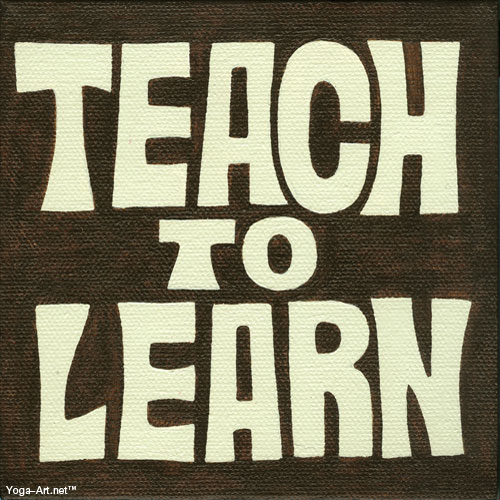
Angelos Morenao, Yoga-Inspired Art

Angelos Morenao, Yoga-Inspired Art, Yoga-Art.net

Approaching a complex organizational performance need in this way has several benefits:

  • Empowers active learning
  • Teaching, by its very nature, reinforces and deepens learning
  • Builds collaboration and organizational learning culture – learners are in it together
  • Creates internal experts for future help
  • Allows the trainer/ID to relax and let others do their work for them

Sadly, that last point is not even remotely true. But, it does make us approach our role quite differently. Rather than tight authority over a specific e-learning track or training room, we open our controlling fist to the chaos of the crowd. What that means is we become curators, coaches, mentors and evaluators.

  • Curate: We provide the materials, links, and other resources that are going to allow learners to build and contextualize their growing expertise in their area.
  • Coach: We want to monitor, redirect and reward learning along the way; in particular, we will need to guide how they intend to teach what they are learning. Training is hard, and we know it is a skill that many don’t have naturally. So…
  • Mentor: We need to work with individuals to find their strengths in how to present the content (talking, demonstrating, visual depiction, metaphoric illustration, interpretive dance, etc.).
  • Evaluate: Was our flipped method successful? What follow-ups, resources and continuous learning scaffolds need to be in place to build on both the content and the learning culture that has taken root? (Seems like a great place to start an online Community of Practice, but that is a topic for/from another day.)

Seen this way, our job is less to prepare and deliver training “products” or “events,” and more about adjusting to a digital age learning culture. The constant stream of information is relentless, and we need to help our learners make sense of it and flourish beneath the deluge.

Objection Sustained? Not if you hit objections head on

7 Oct

Not all people welcome even well thought-out and executed training. (Shocking, I know!)

Some find it irrelevant. Others, that it is an unwelcome interruption to their already overflowing schedules. There are also people who object to the nature of a specific type of training, such as compliance or harassment training.  Some are simply hostile to the entire notion of training.

In planning a training activity, we need to dedicate part of our needs analysis and instructional design time to investigate and plan methods to address learner objections and obstacles. We should never assume that negative attitudes are unimportant nor simply ignore (what may be) valid attitudinal barriers to our efforts. I’ve found that the best way to address these issues is by engaging a learner up front with the relevance of the topic at hand.

Make it personal; tell a story. This is important to her because there may be real consequences – organizational, legal, and personal – to her or her colleagues if performance objectives here are not learned and internalized. If you can’t discover the direct relevance of a particular course, see this earlier post or the Cathy Moore topic it refers to.

Learning is there to be found: How about an atlas?

9 Aug

Yesterday I had the pleasure to facilitate our home-grown, Portland-based learning professional’s group, the Collaborative Learning Network. (A big hats off to the IdeaLearning Group for bringing the CLN to life.) The topic I chose was the (purposely) vaguely titled, “The Evolving Role of the Modern Training Professional.”

I was equal parts heartened and disappointed to hear that pretty much everyone else was having the same struggle I was in figuring out how to leverage our world awash with digital artifacts into something to empower learners’ ability to take charge of their own learning. We touched on the idea that curated content could be an answer: Either curated and served in a defined “pool” of content, or learner-discovered and curated collections to demonstrate one type of learning outcome.

While we barely scratched the surface, the idea of curation has been rolling around my head a lot lately. A future topic for CLN, perhaps?

Serendipitously, while I was flipping though my scoop.it recommendations this morning, I came across The EduPunks’ Atlas of Lifelong Learning. A periodic table of sorts (and sort-able!), it organizes a galaxy of learning portals for the motivated seeker. While it has an academic bent, it’s got me wondering if something similar might work for specific adult learning/training topics.

It’s an idea to marinate a bit. In the meantime, check it out:

Image

Flipped classroom and Instructional Design: Flip me!

19 Jul

My workplace’s primary historical purpose was to improve, support, and supplement classroom teaching. And while Education Northwest’s scope has expanded over the years, there are thankfully still many very smart people steeped in the world of education and scholastic excellence.

I am not one of them.

My background, as you know if you’ve read this blog before, is in Instructional Design (ID) and e-learning, especially for adult workers (i.e., training). This is both a challenge and opportunity. On a day-to-day level, it means learning each other’s terms, nomenclature, and assumptions, so we are speaking a common language when we talk about projects and solutions.

A colleague recently pointed to th

Interaction is essential for class room learning.

Interaction is essential for class room learning.

e (terrific) trend toward “flipped” classrooms, where teachers spend most of the class time coaching hands-on activities while allowing students to watch the “lecture” online, suggesting that this was a step closer to what I do. Yes, a challenge and an opportunity.

While watching lectures, TED talks, videos, and other infotainment is all well and good, it is in fact not what we IDs and e-learning designers do. When instructors or trainers stand in front of learners, whether to lecture or to train, they have an immediate feedback loop: The learners are engaged, bored, eager, confused, frustrated, etc. Through conversation, application, and exercises, the instructor has an immediate way to judge success and failure. It is a true two-way give-and-take, and good trainers (and teachers) thrive in that environment.

When we think about e-learning, we start with the learner—alone, at a screen, hoping at best to have a useful and mildly engaging 15 minutes, but fearing pages of text that bore him to tears and from which he will retain next to nothing. (Well, there’s always email, solitaire or less wholesome ways to pass the time if forced to sit at a screen.)

An ID’s job is to design something to surprise, delight, and exceed those dreary expectations.
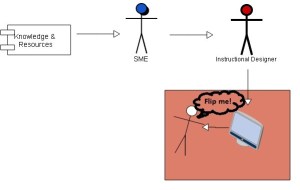
IDs think about the lonely learner: "How can I reach these kids?"

IDs think about the lonely learner: “How can I reach these kids (or adults)?”

How can we replace that human classroom experience with a learning experience that engages learners and, in its most elevated form, allows them to transfer the knowledge and skills to their work performance? That is our starting point. Creating that design is part science and part art. It requires a deep understanding of the topic, and then combines it with the science of how people learn, how they might apply what they’ve learned to real life, and what kind of activities convert a screen watcher into an immersive participant in his own learning. That’s what e-learning specialists do.

Anyone with modest proficiency can tape a lecture or throw slide sets online and call it learning. At best, it’s an interesting invitation that might lead to learning: The flip in the flipped classroom is where the magic happens. E-learning delivers the flip, not (just) the lecture.