Archive | Information Fluency RSS feed for this section

Forget the Content: It’s the people you need to align

31 Jul

“All organizations are perfectly designed to get the results they are now getting.” –Tom Northrup

Implementing a learning program is a serious challenge, and as often as not (more often than not?) the program fails to deliver the anticipated results even with sufficient budget and organizational support. There are, of course, many reasons why learning programs fail. In most cases, the first place evaluators look is at the content. If only the content were better, more relevant, or more useful, people would learn and apply it. In my experience, content is rarely the culprit. If there’s one thing good instructional designers and eLearning practitioners have down, it’s SME engagement and creating good learning objectives. Even if the content were not as robust as it could or should be, that’s rarely the barrier.

The second place that we turn to is the learning design. Was the instruction not designed with the learner in mind? Was it not well “chunked” or paced? Was it not interactive and with appropriate scenarios and learner challenges? These are all good questions, and can often lead to useful ameliorations. If the topic is not perceived to be relevant or immediately applicable to the learner, transferable learning is unlikely to happen. Again, good learning designers will have avoided these problems in the first place, or be very good at seeing those flaws at an early implementation stage.
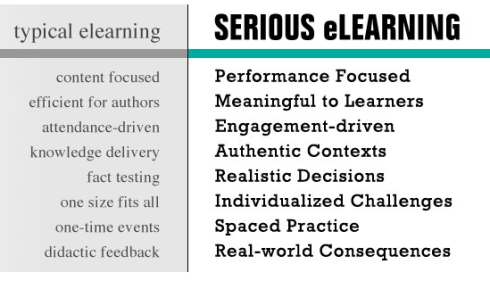
This post boils down to what the Serious eLearning Manifesto addresses.

This posts boils down to what the Serious eLearning Manifesto addresses.

The last place we focus the blame is on the learner. Or, perhaps better stated, the last place we publicly lay the blame is on the learner, though we are all well aware of some deep-seated variety of, “These folks will never get it, but we can say we’ve tried.” Leaving aside the misplaced emphasis on “getting it” rather than “doing it,” we are left that the learner is actually where the breakdown occurs.

If we think that’s the case, it remains the instructional designer’s problem to fix. The problem is NOT that people won’t or can’t learn, and transfer that learning. The problem is that we haven’t asked them to do so in a meaningful way.

Work with people, not the content.

Information (content) is there for all. Learning is individually motivated, but also takes place in a social framework. If you give a music lover a new music player whose features are not so obviously designed as to be transparent (now there’s an interesting topic!), she will learn how to use it in a matter of minutes and be expert in a handful of hours. There’s no need for an instructional course. Why? The conditions are right for learning:

  • There is intrinsic motivation to figure it out.
  • The usefulness of taking the time to learn it is obvious (if it’s not, forget it).
  • The learner feels empowered to take the time to learn it; no people or forces are aligned that implicitly or explicitly say you’re wasting your time or that you don’t need to know it (or if there are, contrarian rebellion can be a useful force!).
  • There is an immediately (if perhaps only implied) social aspect to learning it; she’ll be one of the “cool kids” or will want to share the player—and her knowledge of it—with others.

The answer is not in our courseware, but in our design of the learning space. Empower learners to learn, provide the supports and freedom that encourage personal and social learning, and leave the tools and topics you want them to explore on the table.

Learning happens, every day. We just need to understand how to direct that in ways that benefit our learners and organizations. If our efforts are not yielding the desired results, examine the organization that is delivering those results.


Learning Is Our Job… it’s not just me (or us).

11 Jun

I received a tweet from a friend who happened to be attending DrupalCon in Austin last week. He referred to a remark by a keynote speaker:

jones tweet

You can see my response to the original message above (with poor syntax– but is it grammatically incorrect?).

I was truly heartened to see that the constantly-learning ethos is becoming a mantra beyond the domain of PD/L&D/ID/ELP/SPOTDA* folks. As I’ve argued before in several places, our jobs are to keep learning. Very few of us have a job or career that spans more than a few years at a time. Even if we stay with the same organization, whatever our job is today will very likely not be what our job is two years from now, at least the tools, methods and systems we operate under. (And if it is, ask yourself, “Why!?”)

No, our careers are now tied to learning. And learning is not a solitary endeavor. We learn only in so far as we can seek, catalog, retrieve and share new facts, ideas and methods. That’s where I see us PD/L&D/ID/ELP/SPOTDA* folks gaining in relevance. Most of us are at a loss on how to take that learning management, or Personal Knowledge Management (PKM, in the parlance of our day) from a chaotic hit-or-miss activity to a systematic practice. Nobody taught us how to learn in the digital age, but it is an – the – essential challenge of our careers.

………………………..

PD – Professional Development

L&D – Learning and Development

ID – Instructional Design

ELP – E-learning Practitioners

SPOTDA – Smart People of the Digital Age

Learning in a Connected Workplace: But connected to what, exactly?

5 May

Workplace learning. If your mind fills with images of shuffling off to a conference room to “do the training,” you share the attitude of a large share of learners, I’m afraid. Luckily for us, we’re e-learning folks, so we know better. Learners don’t have to shuffle anywhere anymore. They can “do the training” right at their desk.

Sigh.

If we are satisfied with delivering e-learning courses, 2004 called and wants it’s training program back. If we rely solely on delivered courses, we are losing ground and selling our learners, organizations, and ourselves short. E-learning is great (or should be), and it’s not going anywhere. However, we have to think beyond e-learning development to become true instructional design and adult learning facilitators. You know all too well the two major shifts of the last decade:

  • Information now streams at your learners’ fingertips, constantly on and maddeningly (and wonderfully) distracting.
  • Work is no longer only task-driven, but also learning- and innovation-driven.

That software training you’re working on? Or leadership training? Sales training? Compliance training? You-name-it training? Someone else has already created it, probably better, whether it’s off the shelf or up on Lynda.com. Not only that, there are Twitter hashtags and Facebook threads and meme jokes and outright snarkiness out there about your very topic. And here’s the irony: You want the kind of learners who will find it! They are engaged and curious, and they have at least enough initiative to forward a funny poster. The capacity for nearly anyone to find information on nearly anything is inspiring and horrifying. Our job as learning professionals is to help people harness the flow, teaching them how to evaluate, store, share, and use what they find.

Which leads to the second point: Learning is not a separate part of the calendar, or even a set-aside part of the day.

LEAP Ahead Conference: Portland, Ore., June 25-26

LEAP Ahead Conference: Portland, Ore., June 25-26

Modern working is learning. The latest headlines, industry trends, job tools, and data points are essential to helping workers succeed in almost any industry. We’re all knowledge workers now, and to be a knowledge worker is to be a constantly learning worker. If we fail to learn and convert that learning into innovation, not just as an organization but as individuals, we’re being left behind by those who do.

The same is all too true for those of us in the e-learning game. What have we been learning? What innovations are we implementing? And how are we sharing it? Let’s find out! Join me as we dive into this topic at LEAP Ahead in Portland next month.

How do I use this thing? Learning to learn from e-learning

18 Apr

It is a timeless scene: A high school class is about to begin, and just about every student pulls out their notebook and pen, perhaps a text, ready for the lesson. Inevitably, there are always one or two kids who just sit there, empty-handed and desk uncovered. The teacher wearily prompts those students: “Would you care to join the class today by getting out your notebook and pen?” Most of the time, with visibly exaggerated fanfare, they will prepare to join

At least he Jeff didn't come empty handed.

At least Spicoli didn’t come empty handed.

the lesson.

These kids don’t need to be told how to learn in class. Most will take notes, raise hands, ask questions, highlight text. But there is nothing instinctive or natural about it. They have learned through their school years how to learn, or at least how to give the appearance of learning. They do it because they were taught to do it, and it is a skill that improves with practice. (Whether this is a good system for a modern classroom is debatable, but that’s not the point here.)

Even though I have been designing e-learning for years, I was recently reminded of the importance of teaching learners how to learn in what for many may be an unfamiliar learning environment: alone at their screen. Instructional designers should know that learner analysis is part of the job, but we should dig in to find if there is a place to learn how to learn in our e-learning programs. It took this video from the Global Online Academy to remind me of this valuable lesson.


While we can safely assume that manipulating mouse and keyboard through an e-learning course is a familiar enough activity, we should not assume that learners know how to use it as they would a live, classroom session. Depending on our audience, we may need to take on the responsibility to teach learners effective ways to learn from an online course. Strategies may include:

  • Copying-and-pasting into a digital notebook
  • Bookmarking more difficult sections to return to after an initial pass
  • Pointing out ways to contact subject matter experts (SMEs) and instructional designers to answer questions
  • Using course links effectively
  • Doing independent search, clip, compile and share activities around the topic (PKM), formally or informally
  • Taking traditional notes on paper (back to the future!)

Moving social learning from tadpoles to guppies: First the bucket, then the pool

6 Apr
Thanks, Jane. http://c4lpt.co.uk

Thanks, Jane. http://c4lpt.co.uk

I saw a great quote from a presentation by Jane Hart the other day, via a tweet by Tracy Parish (@Tracy_Parish): “You can’t train people to be social, only show them what it is like to be social.” As usual, Jane is quite right.

But, showing is only part of it. Showing the introvert or resolute wallflower what it is to mingle at the office party will not convert anyone to a new behavior. At minimum, a bit of gentle coaxing and some handholding are in order. A more structured ice-breaker or purposeful conversation period would likely go a long way to integrate the cautious.

Thinking about how to coax the shy or fearful reminded me of the swimming lessons I used to teach as a teenager. I was given the group of 5-to-7-year-olds who were afraid to get in the water. For them, dangling their feet in the water was an entire first lesson. It was several lessons to build up enough confidence for The Bucket. Each tadpole was given a bucket big enough to fit their heads. Each student filled their buckets with water, and step-by-slow-step we would work together until they could submerge their heads: First one ear, then the other. Then the top of the head. Eventually the face, and once they could do that, the entire head in for 10 seconds. It was amazing the sense of accomplishment these kids felt with their new-found ability to stick their heads in the water and hold their breath. From there, getting into the pool didn’t seem so scary.

bucket

Social Learning?: Get the bucket!

All the while, they could see the guppies kicking around on their kickboards and even doing some real swimming – the role model of those little fish was the crucial unspoken motivation.

OK, perhaps the analogy is a bit strained, but here’s the point: The tadpoles had the tool (the pool), and the model (the guppies), but there was no way that would be enough for them to get into the pool without the planning and instruction that class provides. I don’t think that social workplace learning is so different. You can tell people about the benefits, provide great tools, and even show them how your vanguard group of social learners use it. But there’s no substitute for putting the structures in place to allow people to experiment in a safe environment. So, even though social learning by nature is without hierarchy or preconceived goals, it will not be as inclusive or ultimately as useful without learning structures – and learning professionals to guide tadpoles in their development into guppies.