Archive | Digital Literacy RSS feed for this section

Learning Experience: There is no end.

29 May

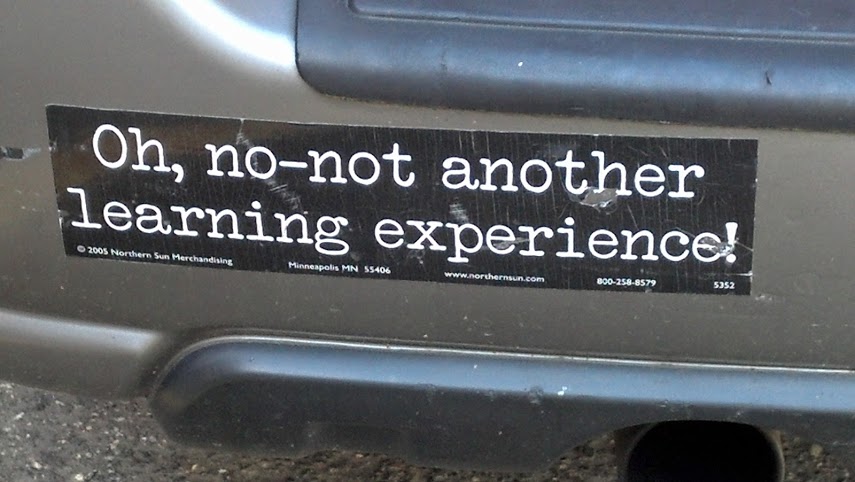
I came across this funny bumper sticker the other day. And while I’m quite certain neither the creator nor the car owner had adult learning practice in mind, it is apt. Learning happens, every day, all day, with or without us.
learning exp

When our jobs were mostly process- and product-based—manufacturing, service, design—ongoing professional and personal learning may not have been as important. There was a time when you could practice your job, advance your career and even feel satisfied without contemplating the ways in which learning impacted your development. That time rests in the dustbin of history, at least for those of us who are “information,” “knowledge,” or “learning” workers.

We are constantly learning now, so the questions for us in the adult learning game are

  • How are people learning?
  • How do we guide people to learn what we want/avoid what we don’t want them to learn?
  • How do we facilitate ongoing learning?
  • How do we know if and how learning is applied to jobs and innovation?
  • Where does traditional, formal learning (live training, e-learning, blended, etc.) fit in?

The only thing we can say with any certainty is that for most of us, whatever our job is today won’t be our job five years from now. Our career is learning, learning is our career: The better we adapt to that reality the better we’ll be. I say, bring on the learning experiences!

How do I use this thing? Learning to learn from e-learning

18 Apr

It is a timeless scene: A high school class is about to begin, and just about every student pulls out their notebook and pen, perhaps a text, ready for the lesson. Inevitably, there are always one or two kids who just sit there, empty-handed and desk uncovered. The teacher wearily prompts those students: “Would you care to join the class today by getting out your notebook and pen?” Most of the time, with visibly exaggerated fanfare, they will prepare to join

At least he Jeff didn't come empty handed.

At least Spicoli didn’t come empty handed.

the lesson.

These kids don’t need to be told how to learn in class. Most will take notes, raise hands, ask questions, highlight text. But there is nothing instinctive or natural about it. They have learned through their school years how to learn, or at least how to give the appearance of learning. They do it because they were taught to do it, and it is a skill that improves with practice. (Whether this is a good system for a modern classroom is debatable, but that’s not the point here.)

Even though I have been designing e-learning for years, I was recently reminded of the importance of teaching learners how to learn in what for many may be an unfamiliar learning environment: alone at their screen. Instructional designers should know that learner analysis is part of the job, but we should dig in to find if there is a place to learn how to learn in our e-learning programs. It took this video from the Global Online Academy to remind me of this valuable lesson.


While we can safely assume that manipulating mouse and keyboard through an e-learning course is a familiar enough activity, we should not assume that learners know how to use it as they would a live, classroom session. Depending on our audience, we may need to take on the responsibility to teach learners effective ways to learn from an online course. Strategies may include:

  • Copying-and-pasting into a digital notebook
  • Bookmarking more difficult sections to return to after an initial pass
  • Pointing out ways to contact subject matter experts (SMEs) and instructional designers to answer questions
  • Using course links effectively
  • Doing independent search, clip, compile and share activities around the topic (PKM), formally or informally
  • Taking traditional notes on paper (back to the future!)

Moving social learning from tadpoles to guppies: First the bucket, then the pool

6 Apr
Thanks, Jane. http://c4lpt.co.uk

Thanks, Jane. http://c4lpt.co.uk

I saw a great quote from a presentation by Jane Hart the other day, via a tweet by Tracy Parish (@Tracy_Parish): “You can’t train people to be social, only show them what it is like to be social.” As usual, Jane is quite right.

But, showing is only part of it. Showing the introvert or resolute wallflower what it is to mingle at the office party will not convert anyone to a new behavior. At minimum, a bit of gentle coaxing and some handholding are in order. A more structured ice-breaker or purposeful conversation period would likely go a long way to integrate the cautious.

Thinking about how to coax the shy or fearful reminded me of the swimming lessons I used to teach as a teenager. I was given the group of 5-to-7-year-olds who were afraid to get in the water. For them, dangling their feet in the water was an entire first lesson. It was several lessons to build up enough confidence for The Bucket. Each tadpole was given a bucket big enough to fit their heads. Each student filled their buckets with water, and step-by-slow-step we would work together until they could submerge their heads: First one ear, then the other. Then the top of the head. Eventually the face, and once they could do that, the entire head in for 10 seconds. It was amazing the sense of accomplishment these kids felt with their new-found ability to stick their heads in the water and hold their breath. From there, getting into the pool didn’t seem so scary.

bucket

Social Learning?: Get the bucket!

All the while, they could see the guppies kicking around on their kickboards and even doing some real swimming – the role model of those little fish was the crucial unspoken motivation.

OK, perhaps the analogy is a bit strained, but here’s the point: The tadpoles had the tool (the pool), and the model (the guppies), but there was no way that would be enough for them to get into the pool without the planning and instruction that class provides. I don’t think that social workplace learning is so different. You can tell people about the benefits, provide great tools, and even show them how your vanguard group of social learners use it. But there’s no substitute for putting the structures in place to allow people to experiment in a safe environment. So, even though social learning by nature is without hierarchy or preconceived goals, it will not be as inclusive or ultimately as useful without learning structures – and learning professionals to guide tadpoles in their development into guppies.

Webbie Winners: Are IDs and e-learning folks keeping up?

4 Mar
lifesaver uk

From life-saver.org.uk — an amazing interactive learning video. It takes a while to load, though.

I had the good fortune to squeeze out 45 minutes to breeze over the latest Webbie Award 2013 winners. It was not nearly enough. However, as is my habit, I diligently clipped the winners or nominees that drew my eye to something that might be applicable to e-learning and learner engagement. This is a great example of how and why I am so enthusiastic about PKM (Personal Knowledge Management). But that is a topic for another day.

So, what can e-learning practitioners glean from Webbie winners?

Trends:

Think Beyond the Course

8 Nov

Training is not a singular event. The notion of “doing to the training” was never a useful paradigm, but even less so now with our always-on digital world. What information will the learner have already found on his own before taking the course? What social media posts has he already read about the training event he is set to undertake? After the fact, where will he turn and what will he discover to reinforce, amplify, or potentially torpedo the e-learning activity?

Learning is an ongoing activity that now takes place significantly online. ImageRather than think of e-learning as an event, smart organizations deliver timely useful information throughout the year on a continuous basis. People are always going to search for interesting, useful and engaging information. Human nature demands we find patterns, connect the dots, synthesize information.

How does your organization deliver information so that people are learning lessons that map to their success? And, how do e-learning products, be they courses, webinars, job aids, social media posts, etc., fit in to that larger strategy? We need to step back to consider if the digital milieu supports or undermines effective training, and take action accordingly (see more on this from Jane Hart). E-learning becomes an act of information curating rather than – or in addition to – creating content.