Archive | Digital Literacy RSS feed for this section

Dr. Neil deGrasse Tyson did what on stage?!

7 Nov

When I saw that Neil deGrasse Tyson was to be the keynote speaker at DevLearn2014, I thought it was an odd choice. A pleasant surprise, certainly, but in my mind I struggled to imagine how his ideas on space and time would set the tone of our eLearning conference. As it turns out, he was a terrific choice.

I should have trusted that he would be smart enough (duh!) and savvy enough about public appearances to know how to hold an audience’s attention and bend the content to resonate well. Dr. Tyson absolutely delivered the goods.

In a far-ranging but fascinating 45 minutes, he discussed everything from his childhood primary and secondary school experiences to his perspectives on the ways in which culture informs the scientific community. Why is it that we have been lamenting STEM/STEAM education in the United States, and yet our nation continues to be among the leaders in scientific discover and Nobel Prizes awarded? He argued that it is our culture that allows us to question authority and that values frontiers – both physical and mental.

But what I was most excited to see from him was when he paused, mid-sentence, to tweet a thought that had just occurred to him. He was talking about how we are so interconnected with each other now via social media, and how one idea can ricochet around the globe at the speed of media feeds and typing thumbs. As he was contemplating what this means for the scientific community, he went on a slight tangent to discuss how just that week Pope Francis had remarked that science and the church are not at odds, and how he accepts evolutionary science and modern astronomical thinking. He paused….

We watched, in silent appreciation (I appreciated it anyway – I guess I can’t speak for all) as he took his phone out of his pocket and tweeted:

I have been making the case that social media in the workplace is only a distraction if you allow it to be. It is not only another way to capture important notes and thoughts, it is a channel to share those thoughts with tens, hundreds or (in his case) tens of thousands of followers instantly. I welcome people staring at their screens and moving their thumbs during my meetings and trainings. If the content is useful and engaging, then they are demonstrating engagement just as much as if they were taking notes on paper. If they are bored and disengaged, then they would be so with or without their little screens.

As Dr. Tyson says: “We want to feel connected, want to feel relevant, want to feel like a participant in the goings-on in activities and events going-on around you.” (1:53 – 2:08 in the video below.) Social media in the workplace-learning place is just another avenue for that engagement.

http://youtu.be/9D05ej8u-gU

Pachinko, Buckyballs and Atomic Collision

23 Oct

Last week I posted an uncharacteristically physics-themed post. I really should not use analogies that I don’t fully understand. But, in the spirit of learning as I work, I’m going to double down on physics analogies, and continue the chain of thought I started. (To get a reaction, get it?)

Content nuggets – facts, resources, procedures, insights – are little silver balls. The balls are all over: They are in your servers, in cloud-based databases, in documents and in people’s heads. Also, in the back of file drawers and on thumb drives.

pachinko

Pachinko machine.

Letting balls drop down, careening from who knows where to a stable resting spot isn’t a very effective way to manage knowledge. Sometimes we get lucky, and balls will fall into place and deliver a little prize. I think of this as pachinko, the random-chance gambling game where glassy-eyed players watch the balls drop fortune into a cavity of narrow chance.

Along come the trainers and instructional designers: We are not satisfied to let the pachinko balls fall where they may. We understand that adult learners want to see shapes, identifiable patterns and have a vocabulary to talk about them. Like content, we shape them to be engaging and memorable, and to hold in contrast with other shapes. “Our patterns, the ones we use here, are the ones you need to remember, apply and return to for professional success.” Some of us have become very skilled at our profession, fashioning elaborate patterns that will DSCN4916stick in learners’ minds and no doubt prove useful for many months or even years. I think of these as Buckyballs, those now infamous little magnetic balls (not for children between 2 and 2,000 months!) that are irresistible to the hand (and, for some it seems, the mouth!). It sure beats random pachinko balls.

However, times changed. Countless little pieces of content are loosed in the world, under the control of no authority. People pick them, place and save or discard them according to their own measure of worth. We might give them a lovely snowflake to work with, but come back in a few days and the shape may be hardly recognizable. The digital-social age – what I call the Learning Age – allows individuals to collect their own content and apply it in new ways. Individuals see knowledge as personal, not organizational. Workers (good ones, the ones we want to keep!) don’t rely on L & D and trainers to provide content anymore. They have all the balls they could ever use and trip over more all day long.DSCN4892

We can sit back and hope that people will have the skills, motivation and foresight to choose wisely and create new and more useful shapes. Change them and change them again. Take note of those who do and help them to become champions of their teams, departments and organizations. The best possible scenario is that a new system of managing the shape-shifting dynamic world, based on collaborative social networks and tools, emerges organically.

Sadly, that kind of organic synergy, especially in a workplace culture that pre-dates 2009(?), is about as likely as hitting the pachinko jackpot. If fortune shines on your organization, bask in the success and take credit for not getting in the way. For the rest of us still relying on snowflakes and trees, it is time to move on. In my experience, most people crave ways to make sense (“sense-making” per PKM) of the random content, din of new tools and flood of ideas bouncing all around them.

Here lies our opportunity. When we can channel the right content, ideas and tools into our semi-controlled chamber, and allow things to collide – “mash up,” as the kids say – new insights and systems arise. The little balls bouncing off each other, like atomic particles, can truly create new, unpredictable molecules that would have been unlikely to exist otherwise. As before, some will be more lasting and useful than others, but the process is ongoing. It requires work, trust and a bit of luck.

  • Work: First, instead of creating shapes, we need to curate balls and determine what catalysts will help create new particles. We need to teach, coach and mentor our learning cohort in what we’re doing, why we’re doing it and the new expectations for managing knowledge (personal and organizational). We need to get managerial buy-in and develop a set of recommended tools and methods (avoid compelling a certain tool or method – you’ll choke off organic innovation). This is where Work/Learn Out Loud (WOL/LOL) frameworks can prove to be very useful.
  • Trust: Once you encourage and coach people how to WOL and share what they know and how they know it, you have to trust the system. That can be hard. Will there be misfires? Wasted opportunities? Even misappropriations and the rare acts of malice? Yes, there may be all of those. But if you have the right people with autonomy to act and a culture that you are proud of, the system will take hold. (If you have the wrong people and a sour culture, you have bigger problems than L & D agendas.)
  • Luck: Sometimes you will need to jump in to redirect, mitigate and add coaching and mentoring time. With luck, these will be minimal after the initial roll-out period. But with all the time not spent on snowflakes, you should have ample resources to be in continuous iteration and improvement mode. Yes, I know, that would be lucky – write back and tell me what it’s like over on that side.

If this all sounds a lot like an earlier post, well… it is the same author. Thanks for reading. As I said, content used to king, now it’s the joker. If you are still trying to wrest the right expertise from your SMEs and shape it into useful learning content, I suggest you’d be better off working the people to shape the content all around them instead. They are slipping down the halls on a carpet of shiny balls already. Give them the tools to make sense of what they already have so they keep rolling along.


Transmission Job: Receiving the right opinions

14 Jul

A colleague challenged me the other day on my premise that the rise of digital social networks had fundamentally changed a person’s approach to gathering data and weighing options to make informed decisions. (Full disclosure: The colleague, Steve Fleischman, is the CEO of Education Northwest, where I work, and someone whom I have a great deal of intellectual respect for. Which is to say, I’ve been mulling on his question for a few days now.)

He offered the example of his decision to have an auto repair done, as his mechanic suggested, or to forgo the work. Does the social-centric, connectivistly-constructed world inform our decision-making process? He argued that it essentially does not. He called a knowledgeable friend, weighed the (hopefully) trusted mechanic’s opinion, and decided to have the work done.

I argued that, certainly within organizations, things have shifted (or are shifting) to alternative ways of decision-making. When we need to make an informed work-place or project-based decision, simply relying on the handful of experts available to us hamstrings both our efforts, and our organization’s agility and long-term viability.

Let’s be clear: I’m NOT suggesting eliciting advice from all quarters, consensus-building or democratic workplace processes. All these more often than not lead to organizational paralysis and an unacceptable lack or agility.

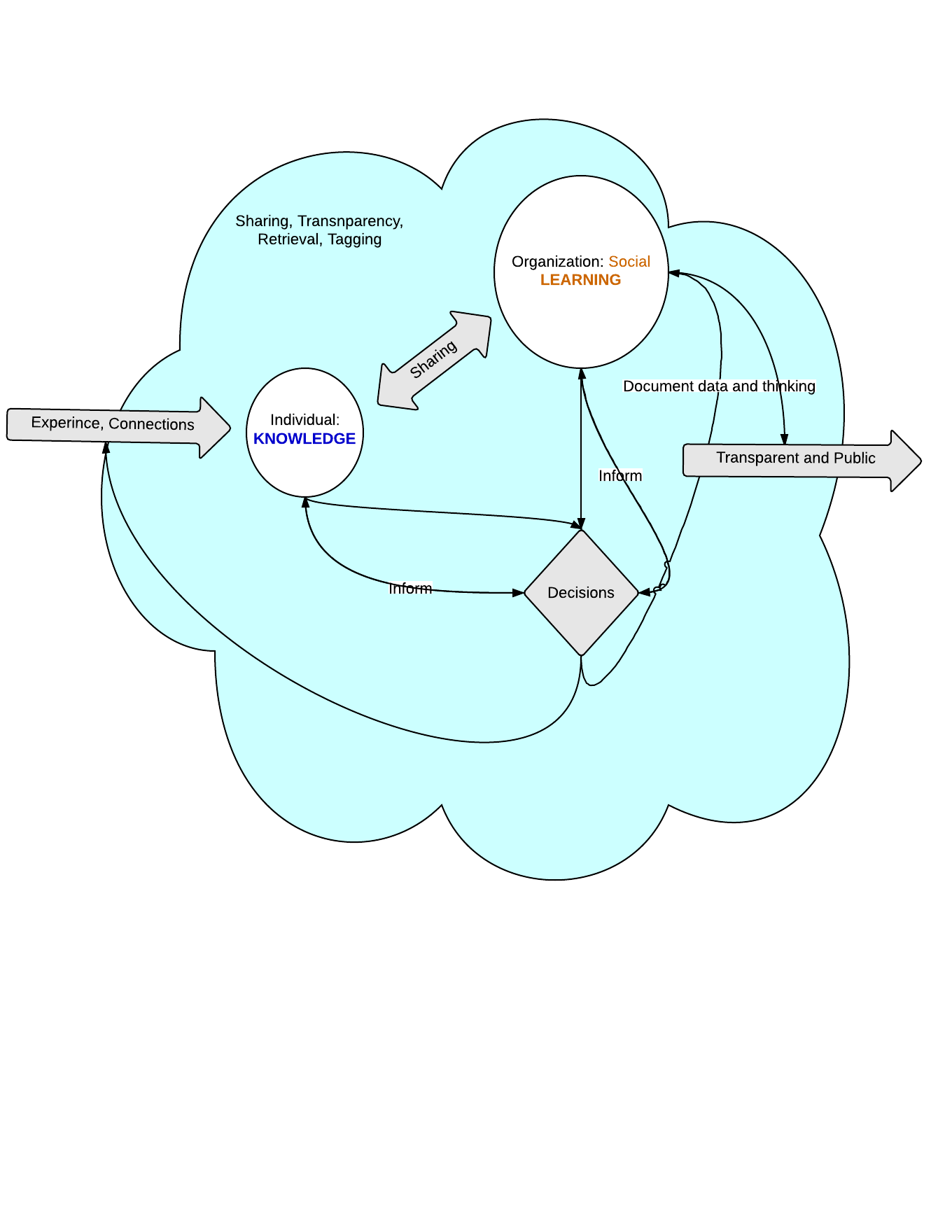
What I am suggesting is that individual knowledge (experience + expertise) be systematically captured, cataloged and shared; at the same time, organizational decision-making be documented and then inform the next divergent event.

My rather poorly-rendered depiction of knowledge-learning-decision loop. The blue could is the systematic practice.

My rather poorly-rendered depiction of  the knowledge-learning-decision loop. The blue cloud is the systematic practice.

This is not an essentially digital learning process: this is what Peter Senge, et. al., have been saying for 20+ years. However, digital-social technology has made this easier, more transparent and in fact far more necessary than ever. Success will shine on those organizations that have the culture and practices to nurture individual knowledge management and growth. Reciprocally, professional development is there for individuals to manage for themselves by the virtuous feedback loop of person-to-organization. Knowledge is personal, learning is social, and they both require deliberate, coordinated management.

So, I can call my Uncle Harold (well, were he still alive) to ask him about my transmission work. But, far better would be to have been following him for the last several years, to follow those folks whom he finds valuable, and for me to share that socially curated content with others, including my mechanic. Then, I’d weigh my mechanic’s recommendation against–or in coordination with–those data points. The final act in this small loop would be for me to share my decision, and the data that informed it, with all who care to find it. It’s the Show Your Work movement, writ small.

Thanks for the challenge, Steve, and happy driving.

Book Club Readings: Learning and Development in our Connected, Online and Social Workplace

18 Jun

I was asked to provide readings for Education Northwest’s book club this month, and to moderate a discussion. The whole process was fun, interesting and revealing. I thought I’d share our reading list here, along with my notes of talking points on each.

Joseph Stiglitz: Creating a Learning Society

Clark Quinn: Revolutionize Learning & Development: Performance and Innovation Strategy for the Information Age, chapters 5 (“Our Organizations”) and 6 (“Our Technology”).

Harold Jarche: Organizational Learning in the Network Era (blog post, 29 May 2014)

Jane Hart: 4 Models of Social Workplace Learning (blog post, 12 June 2014)

Jane Bozarth: Show Your Work: The Payoffs of Working Out Loud, chapter 4 (What is Knowledge? And Why Do People Share it?)

Talking Points for Book Club:

  • Heady times to be in organizational learning and online knowledge
  • Confluence of organizational theory and tech tools
  • A line from global-economic to very personal: Learning is the issue of our time (society, organization, personal)
  • Learning is NOT separate from working: learning is process, practice
  • It’s hard to share (articulate) what you know
  • Structural barriers we may not even be aware of block learning
  • All knowledge is personal; all learning is social

Stiglitz:

If incremental changes impact societal development, learning drives the increments. How do we promote learning in our society? NOT scholastic learning, or formal learning, but culturally adaptive and learning.

Intellectual property can block societal learning because it prevents the free flow of information. Innovation is reduced. Owning vs. Sharing economy.

Impeding learning can lead to lower standards of living.

Quinn:

Premise: Organizations need to be constantly adaptive – never in state but constantly changing, growing.

Clark Quinn's great new book.

Clark Quinn’s great new book.

People need the power to pursue their hunches, expand their roles, self-improve: Remove structural barriers.

Social networks to collaborate, cooperate and both –> coherent organization.

PKM and KM : It’s a practice! (Personal Knowledge Mastery and Knowledge Management)

Traditional organizations have hierarchical information & HR structures which are barriers to being a learning organization.

Three keys to a learning Organization (fig. 5.2)

  1. Supportive Learning Environment
  2. Concrete Learning Processes and Practices
  3. Leadership that Reinforces Learning

Technology is evolving through use, not through technological innovation itself.

Having separate platforms for formal learning and social learning is a false divide. (top of page 60)

Jarche:

Structural impediments to learning must be removed.

Interesting tension: Global, connected, mobile vs. local, personal, contractual.

The only knowledge we can truly manage is my own. How do I feed my knowledge to the organization? And how does the organization nourish me?

Bozarth:

We are terrible at telling people what we know: Hard to articulate, quantify.

Some hoard knowledge because it is the only thing they own: Afraid for their jobs, other’s judgments, lack of professional freedom.

Share is the new save! Work out loud.

Hart:

Social learning needs facilitation, and framework. There are different types of social learning and each needs a slightly different type of hands-on experience.

Learning Is Our Job… it’s not just me (or us).

11 Jun

I received a tweet from a friend who happened to be attending DrupalCon in Austin last week. He referred to a remark by a keynote speaker:

jones tweet

You can see my response to the original message above (with poor syntax– but is it grammatically incorrect?).

I was truly heartened to see that the constantly-learning ethos is becoming a mantra beyond the domain of PD/L&D/ID/ELP/SPOTDA* folks. As I’ve argued before in several places, our jobs are to keep learning. Very few of us have a job or career that spans more than a few years at a time. Even if we stay with the same organization, whatever our job is today will very likely not be what our job is two years from now, at least the tools, methods and systems we operate under. (And if it is, ask yourself, “Why!?”)

No, our careers are now tied to learning. And learning is not a solitary endeavor. We learn only in so far as we can seek, catalog, retrieve and share new facts, ideas and methods. That’s where I see us PD/L&D/ID/ELP/SPOTDA* folks gaining in relevance. Most of us are at a loss on how to take that learning management, or Personal Knowledge Management (PKM, in the parlance of our day) from a chaotic hit-or-miss activity to a systematic practice. Nobody taught us how to learn in the digital age, but it is an – the – essential challenge of our careers.

………………………..

PD – Professional Development

L&D – Learning and Development

ID – Instructional Design

ELP – E-learning Practitioners

SPOTDA – Smart People of the Digital Age