Archive | networks RSS feed for this section

Note to Self: How ’bout a note to all?

29 Dec

We gather for our meeting. Some pull out laptop computers, others prefer pen and paper. We talk over our projects, progress, next steps, risk factors. It’s a scene that plays out every day, to the point where we barely think through the opportunity that each meeting might represent.

We head back to our desks or on to our next meeting. The most organized, resourceful, and determined among us will file notes into whatever organizing system we have devised. Perhaps they’ll reappear in the minutes before the moment of need, either as we work on that project or gather again. Rinse and repeat.

But what if we changed the cycle? What if those meeting notes were out in the open, cataloged for team members and colleagues—and managers and mentees—to find, save, share, and make sense of for their own personal knowledge management (PKM)? I’m proposing that we don’t just save our notes, but use them, share them, integrate them with others, and build both individual and organizational learning.

That kind of transparency has so many benefits:

  • Notes become living documents to add to and glean from.
  • Meetings are more focused, productive, and (maybe) less frequent when show your work/working out loud (#WOL) practices are systemically applied.
  • Managers, stakeholders, and cross-functional coworkers can benefit from knowledge of and insights from the ongoing notes.
  • Potential misunderstandings, cross-purposes, and redundancies can be avoided by sharing freely with teammates.
  • New insights can be found in the notes “feed” from all our of organization’s ongoing work.
  • It helps each of us make better sense of our daily activities.
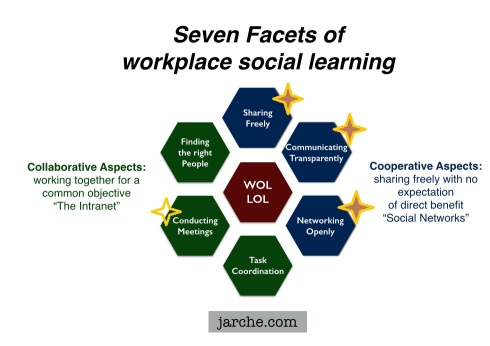
Open note-taking hits several keys of Working/Learning Out Loud. Click image to read H. Jarche's excellent post  and source for this graphic.

Open note-taking hits several keys of Working/Learning Out Loud. Click image to read H. Jarche’s excellent post and source for this graphic.

I hear misgivings and concerns about this practice all the time, and here’s are the three most common:

  1. We already have too much information coming at us, and I can’t take any more inbox filler. There are many ways to manage information, and I recommend that you skip email notifications of any kind. Instead, use wikis, social feeds, SharePoint, ESNs, Google Docs, some project management and CRM tools, etc. It is not hard, and need not clutter; in fact, sharing this way will make long, substantive email chains unnecessary. Ultimately, this is a de-cluttering exercise.
  2. I don’t have time, and we already have too many reporting requirements. There’s the famous story of the delivery driver who claims he is too busy to change his flat tire as he clunk-a-clunks down the street. This is a new way of working, yes, but it doesn’t really require any new skills—you can simply take notes on a public platform instead of a private one. This may not satisfy your reporting requirements, but it will surely save you time when you have to create those reports, and may even make some reports superfluous.
  3. Isn’t that what a CRM system is supposed to do for us? A social CRM would indeed do this, at least in part. Few of us, however, have access to and use a CRM tool in this way. I certainly don’t. I invite those kind readers who do to let me know about it, for the benefit of all of us.

Heads of state (or their staff) take detailed notes and keep diaries to be made public after their terms of service, so that we might make sense of and learn from their decisions and insights. Few of us, however, deal in statecraft, classified files, or even sensitive information. We can benefit from these insights and knowledge today. As Jane Bozarth rightly says, “Share is the new save.” If you note it, there is a good chance others can benefit from it, too. Please, share the wealth.

In a future post, already in draft, I’ll discuss some tools and processes, and invite others to share how they’ve shared notes. But if you want to share your tips, no need to waitI’ll include them in my post and give you credit (if you’d like it).

WonderWOL: Why Work Out Loud?

13 Nov

Next week, November 17 to 21 is International Working Out Loud Week (WOL Week). Education Northwest, my organization, is one that has struggled at times to identify and implement the best ways to share knowledge and increase transparency across areas of work. We are not unique in that. I am hoping that the activities we’re rolling out for WOL Week will advance the cause.

What is WOL, aka Show Your Work? It’s a practice of simply documenting work and/or thoughts about that work, as it is happening or immediately after as an extension of the task. I hear you cringing: Great, more work?! Two short answers before I get into the more meaty whys below. 1. Once in the habit, this will save you work. 2. It’s kind of fun.

There are four main factors that, taken together, I think make a compelling case for doing some form of WOL.

  1. The speed of knowledge: Content is everywhere, data is all around, information streams at us constantly. Knowledge and its application – synthesized information that we can apply in meaningful ways – can run incredibly fast. Not just knowledge of a topic, field, or practice, but also knowledge of how to do things, in this workplace, and with the right tools and processes. WOL can help us keep up, by prompting us to document what we do and how we do it, and to have insight into other’s practices, too.
  2. The movement of people: Very few of us stay at an organization across years and decades anymore (and in this regard, Education Northwest’s staff longevity is an exception to other places I’ve been). Even if we do, the job that we do today isn’t the same as the job we did five years ago or will do five years from now (and if it is, ask WHY!?!). WOL practice is a way to document what we do and how we do it, and helps retain institutional memory and accelerate best practices.
  3. Learning is our primary task: As I’ve argued on numerous occasions, learning is our job: Working is learning, learning is working. See points 1 and 2 above. If we don’t have a method to keep up and keep learning, we are left behind, as individuals in the workforce and in our organizations.
  4. Loss of people whose job it is to know how to get things done: Watch any TV show set
    They knew how to actually get work done, but that' s a by-gone era (for better, mostly). amctv.com

    They knew how to actually get work done, but that’ s a by-gone era (for better, mostly). amctv.com

    in the workplace before 1995, and you’ll see the cadre of people who actually know how to get things done. They were called admins, support staff, interns or junior staff. (In a way Education Northwest is an exception here, too – I’m grateful for the terrific support staff we have.) Need to pull reports? Send a letter to the board? Work the system to get a contractor paid? Now we are meant to be self-reliant. That is, responsible for our professional development and subject AND how to get things done. That’s our world. WOL practices are a great way to address that, too. People are notoriously bad at describing what they actually do to get things done – it’s tucked away between the ears. I don’t know how to get a contractor’s payment though HR and payroll, but surely someone in my organization does and may have shared that info. See? It saves you time!

There are all kinds of reasons to give WOL a try. Don’t worry if you don’t know your hashtags from your hash browns. Use whatever works for you – write a sticky note, take a picture of it, and send it to your colleagues. Join me and the (tens of?) thousands of folks who understand that we need new and better ways to share with each other in our workplaces and across our professions.

#WOL

#WOLWeek

Dr. Neil deGrasse Tyson did what on stage?!

7 Nov

When I saw that Neil deGrasse Tyson was to be the keynote speaker at DevLearn2014, I thought it was an odd choice. A pleasant surprise, certainly, but in my mind I struggled to imagine how his ideas on space and time would set the tone of our eLearning conference. As it turns out, he was a terrific choice.

I should have trusted that he would be smart enough (duh!) and savvy enough about public appearances to know how to hold an audience’s attention and bend the content to resonate well. Dr. Tyson absolutely delivered the goods.

In a far-ranging but fascinating 45 minutes, he discussed everything from his childhood primary and secondary school experiences to his perspectives on the ways in which culture informs the scientific community. Why is it that we have been lamenting STEM/STEAM education in the United States, and yet our nation continues to be among the leaders in scientific discover and Nobel Prizes awarded? He argued that it is our culture that allows us to question authority and that values frontiers – both physical and mental.

But what I was most excited to see from him was when he paused, mid-sentence, to tweet a thought that had just occurred to him. He was talking about how we are so interconnected with each other now via social media, and how one idea can ricochet around the globe at the speed of media feeds and typing thumbs. As he was contemplating what this means for the scientific community, he went on a slight tangent to discuss how just that week Pope Francis had remarked that science and the church are not at odds, and how he accepts evolutionary science and modern astronomical thinking. He paused….

We watched, in silent appreciation (I appreciated it anyway – I guess I can’t speak for all) as he took his phone out of his pocket and tweeted:

I have been making the case that social media in the workplace is only a distraction if you allow it to be. It is not only another way to capture important notes and thoughts, it is a channel to share those thoughts with tens, hundreds or (in his case) tens of thousands of followers instantly. I welcome people staring at their screens and moving their thumbs during my meetings and trainings. If the content is useful and engaging, then they are demonstrating engagement just as much as if they were taking notes on paper. If they are bored and disengaged, then they would be so with or without their little screens.

As Dr. Tyson says: “We want to feel connected, want to feel relevant, want to feel like a participant in the goings-on in activities and events going-on around you.” (1:53 – 2:08 in the video below.) Social media in the workplace-learning place is just another avenue for that engagement.

http://youtu.be/9D05ej8u-gU

Pachinko, Buckyballs and Atomic Collision

23 Oct

Last week I posted an uncharacteristically physics-themed post. I really should not use analogies that I don’t fully understand. But, in the spirit of learning as I work, I’m going to double down on physics analogies, and continue the chain of thought I started. (To get a reaction, get it?)

Content nuggets – facts, resources, procedures, insights – are little silver balls. The balls are all over: They are in your servers, in cloud-based databases, in documents and in people’s heads. Also, in the back of file drawers and on thumb drives.

pachinko

Pachinko machine.

Letting balls drop down, careening from who knows where to a stable resting spot isn’t a very effective way to manage knowledge. Sometimes we get lucky, and balls will fall into place and deliver a little prize. I think of this as pachinko, the random-chance gambling game where glassy-eyed players watch the balls drop fortune into a cavity of narrow chance.

Along come the trainers and instructional designers: We are not satisfied to let the pachinko balls fall where they may. We understand that adult learners want to see shapes, identifiable patterns and have a vocabulary to talk about them. Like content, we shape them to be engaging and memorable, and to hold in contrast with other shapes. “Our patterns, the ones we use here, are the ones you need to remember, apply and return to for professional success.” Some of us have become very skilled at our profession, fashioning elaborate patterns that will DSCN4916stick in learners’ minds and no doubt prove useful for many months or even years. I think of these as Buckyballs, those now infamous little magnetic balls (not for children between 2 and 2,000 months!) that are irresistible to the hand (and, for some it seems, the mouth!). It sure beats random pachinko balls.

However, times changed. Countless little pieces of content are loosed in the world, under the control of no authority. People pick them, place and save or discard them according to their own measure of worth. We might give them a lovely snowflake to work with, but come back in a few days and the shape may be hardly recognizable. The digital-social age – what I call the Learning Age – allows individuals to collect their own content and apply it in new ways. Individuals see knowledge as personal, not organizational. Workers (good ones, the ones we want to keep!) don’t rely on L & D and trainers to provide content anymore. They have all the balls they could ever use and trip over more all day long.DSCN4892

We can sit back and hope that people will have the skills, motivation and foresight to choose wisely and create new and more useful shapes. Change them and change them again. Take note of those who do and help them to become champions of their teams, departments and organizations. The best possible scenario is that a new system of managing the shape-shifting dynamic world, based on collaborative social networks and tools, emerges organically.

Sadly, that kind of organic synergy, especially in a workplace culture that pre-dates 2009(?), is about as likely as hitting the pachinko jackpot. If fortune shines on your organization, bask in the success and take credit for not getting in the way. For the rest of us still relying on snowflakes and trees, it is time to move on. In my experience, most people crave ways to make sense (“sense-making” per PKM) of the random content, din of new tools and flood of ideas bouncing all around them.

Here lies our opportunity. When we can channel the right content, ideas and tools into our semi-controlled chamber, and allow things to collide – “mash up,” as the kids say – new insights and systems arise. The little balls bouncing off each other, like atomic particles, can truly create new, unpredictable molecules that would have been unlikely to exist otherwise. As before, some will be more lasting and useful than others, but the process is ongoing. It requires work, trust and a bit of luck.

  • Work: First, instead of creating shapes, we need to curate balls and determine what catalysts will help create new particles. We need to teach, coach and mentor our learning cohort in what we’re doing, why we’re doing it and the new expectations for managing knowledge (personal and organizational). We need to get managerial buy-in and develop a set of recommended tools and methods (avoid compelling a certain tool or method – you’ll choke off organic innovation). This is where Work/Learn Out Loud (WOL/LOL) frameworks can prove to be very useful.
  • Trust: Once you encourage and coach people how to WOL and share what they know and how they know it, you have to trust the system. That can be hard. Will there be misfires? Wasted opportunities? Even misappropriations and the rare acts of malice? Yes, there may be all of those. But if you have the right people with autonomy to act and a culture that you are proud of, the system will take hold. (If you have the wrong people and a sour culture, you have bigger problems than L & D agendas.)
  • Luck: Sometimes you will need to jump in to redirect, mitigate and add coaching and mentoring time. With luck, these will be minimal after the initial roll-out period. But with all the time not spent on snowflakes, you should have ample resources to be in continuous iteration and improvement mode. Yes, I know, that would be lucky – write back and tell me what it’s like over on that side.

If this all sounds a lot like an earlier post, well… it is the same author. Thanks for reading. As I said, content used to king, now it’s the joker. If you are still trying to wrest the right expertise from your SMEs and shape it into useful learning content, I suggest you’d be better off working the people to shape the content all around them instead. They are slipping down the halls on a carpet of shiny balls already. Give them the tools to make sense of what they already have so they keep rolling along.

Learning Economy: Two disciplines beginning to align

2 Sep

If learning is ultimately about seeing patterns, connecting dots and creating a new synthesized idea, then I suppose this post is evidence of my learning in progress. I’m not sure this is completely baked, but as the saying goes: “If you are waiting for certainty before sharing an idea, you’re waiting too long.”

In addition to my interest in learning, professional development, instructional design, and football(!), I also read a lot of economics and political/social sciences. What I’ve been intrigued to note lately is the confluence of some good economic thinking with the latest trends in learning. Yes, really!

Three ideas that have crossed the divide between economics and learning:

1. Actions lead thoughts, behaviors lead learning. Traditional thinking states that you need to teach adults what they need to know for their jobs, which leads to better performance. That notion is being challenged on many fronts. In fact, both research and practice is showing that guiding actions, providing tools and freeing people to experiment leads to learning in more impactful ways than traditional training and instruction. Learning by doing, or Action Learning, is not a new idea, but it is one that is gaining renewed relevance.

  • Learning: See Jane Hart and Avi Singer, where they (as many others have) point out that learning is the work, and that the ability to extract meaning from tasks, learn from coworkers through collaboration and cooperation, and document what is learned is usually a more powerful learning experience than formal training and professional development courses.
  • Economics: See Ricardo Hausmann:

“Once upon a time, IBM asked a Chinese manufacturer to assemble its Thinkpad – using the components that it would supply and following a set of instructions – and send the final product back to IBM. A couple of years later, the Chinese company suggested that it take responsibility for procuring the parts. Later, it offered to handle international distribution of the final product. Then it offered to take on redesigning the computer itself. Soon enough, it was no longer clear what IBM was contributing to the arrangement. Learning to master new technologies and tasks lies at the heart of the growth process.”

2. Openness and collaboration trump safeguards and secrets. Allowing actions to lead learning requires an openness to allow the learning process to occur, even as the work unfolds. If management can overcome that mental hurdle, a treasure of potential may be realized.

“In the world of talent, learning and performance (“The Collaboration Age”) …[it’s] those who share and work together who are the winners. Those who hide behind organisational [sic] garden walls end up deep in weeds. If we’re to succeed …We need to do so with others, in some cases even with our competitors. The rather ungainly term ‘co-opetition’ is being increasingly used to define co-operative competition, where competitors work together to achieve increased value at the same time as they are competing with each other.”

“If, while learning, you face competition from those with experience, you will never live long enough to acquire the experience yourself. This has been the basic argument behind import-substitution strategies, which use trade barriers as their main policy instrument…. The problem with trade protection is that restricting foreign competition also means preventing access to inputs and knowhow.”

3. Deliberate, programmatic supports for learning are key. Far from being a call for laissez-faire policies, organizations and societies that can create the structures to nurture systemic learning will thrive in the 21st century. It may on the surface appear as if I’m recommending soft management to allow people to run down any hunch or notion as they wish. While the freedom to explore – and social-learning-for-work-1-638fail—is important, this calls for deliberate structures and new managerial approaches to work well. Building silos and setting rules is easier than guiding and mentoring adaptation, and begs for more innovative managerial skills.

  • Learning: As Harold Jarche rightly points out, the managerial skill needed for modern work is the ability manage complexities, not hierarchies.

“Sharing complex knowledge requires strong interpersonal relationships, with shared values, concepts, and mutual trust. But discovering innovative ideas usually comes via loose personal ties and diverse networks. Knowledge intensive organizations need to be structured for both. Effective knowledge-sharing drives business value in a complex economy.”

stiglitz“Successful industrial policies identify sources of positive externalities – sectors where learning might generate benefits elsewhere in the economy… Virtually every government policy, intentionally or not, for better or for worse, has direct and indirect effects on learning. Developing countries where policymakers are cognizant of these effects are more likely to close the knowledge gap that separates them from the more developed countries. Developed countries, meanwhile, have an opportunity to narrow the gap between average and best practices.”

So what’s the insight here? The ways in which our world is increasingly based around dispersed networks rather than hierarchies is changing the way we work–which is to say, learn. On the macro-economic level, for the organizations in which we work, and in our increasing responsibility for our own learning and professional development, we’re relying on network-based relationships where nexuses of knowledge and various levels of association are as shifting as our conditions and motivations of the moment.

If you’re reading this, you are part of exactly what I’m describing. I’m glad to have your open association and welcome your thoughts.