Archive | learner design RSS feed for this section

Learning Experience: There is no end.

29 May

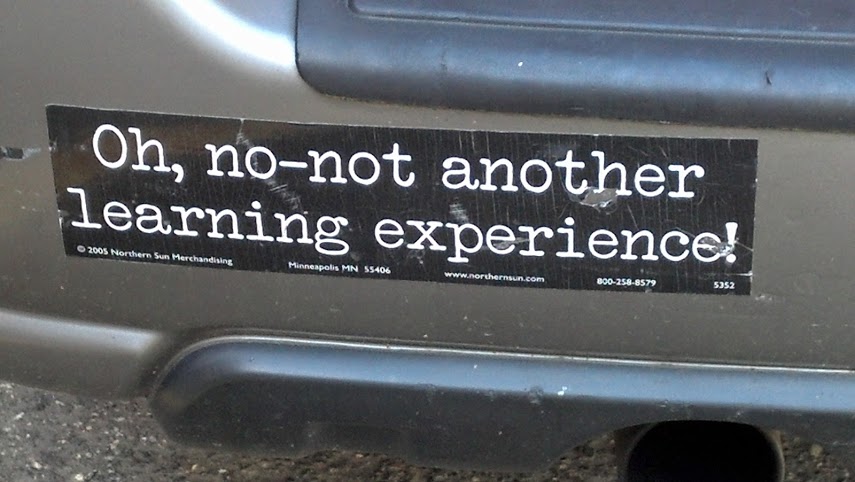
I came across this funny bumper sticker the other day. And while I’m quite certain neither the creator nor the car owner had adult learning practice in mind, it is apt. Learning happens, every day, all day, with or without us.

learning exp

When our jobs were mostly process- and product-based—manufacturing, service, design—ongoing professional and personal learning may not have been as important. There was a time when you could practice your job, advance your career and even feel satisfied without contemplating the ways in which learning impacted your development. That time rests in the dustbin of history, at least for those of us who are “information,” “knowledge,” or “learning” workers.

We are constantly learning now, so the questions for us in the adult learning game are

  • How are people learning?
  • How do we guide people to learn what we want/avoid what we don’t want them to learn?
  • How do we facilitate ongoing learning?
  • How do we know if and how learning is applied to jobs and innovation?
  • Where does traditional, formal learning (live training, e-learning, blended, etc.) fit in?

The only thing we can say with any certainty is that for most of us, whatever our job is today won’t be our job five years from now. Our career is learning, learning is our career: The better we adapt to that reality the better we’ll be. I say, bring on the learning experiences!

Learning in a Connected Workplace: But connected to what, exactly?

5 May

Workplace learning. If your mind fills with images of shuffling off to a conference room to “do the training,” you share the attitude of a large share of learners, I’m afraid. Luckily for us, we’re e-learning folks, so we know better. Learners don’t have to shuffle anywhere anymore. They can “do the training” right at their desk.

Sigh.

If we are satisfied with delivering e-learning courses, 2004 called and wants it’s training program back. If we rely solely on delivered courses, we are losing ground and selling our learners, organizations, and ourselves short. E-learning is great (or should be), and it’s not going anywhere. However, we have to think beyond e-learning development to become true instructional design and adult learning facilitators. You know all too well the two major shifts of the last decade:

  • Information now streams at your learners’ fingertips, constantly on and maddeningly (and wonderfully) distracting.
  • Work is no longer only task-driven, but also learning- and innovation-driven.

That software training you’re working on? Or leadership training? Sales training? Compliance training? You-name-it training? Someone else has already created it, probably better, whether it’s off the shelf or up on Lynda.com. Not only that, there are Twitter hashtags and Facebook threads and meme jokes and outright snarkiness out there about your very topic. And here’s the irony: You want the kind of learners who will find it! They are engaged and curious, and they have at least enough initiative to forward a funny poster. The capacity for nearly anyone to find information on nearly anything is inspiring and horrifying. Our job as learning professionals is to help people harness the flow, teaching them how to evaluate, store, share, and use what they find.

Which leads to the second point: Learning is not a separate part of the calendar, or even a set-aside part of the day.

LEAP Ahead Conference: Portland, Ore., June 25-26

LEAP Ahead Conference: Portland, Ore., June 25-26

Modern working is learning. The latest headlines, industry trends, job tools, and data points are essential to helping workers succeed in almost any industry. We’re all knowledge workers now, and to be a knowledge worker is to be a constantly learning worker. If we fail to learn and convert that learning into innovation, not just as an organization but as individuals, we’re being left behind by those who do.

The same is all too true for those of us in the e-learning game. What have we been learning? What innovations are we implementing? And how are we sharing it? Let’s find out! Join me as we dive into this topic at LEAP Ahead in Portland next month.

Moving social learning from tadpoles to guppies: First the bucket, then the pool

6 Apr
Thanks, Jane. http://c4lpt.co.uk

Thanks, Jane. http://c4lpt.co.uk

I saw a great quote from a presentation by Jane Hart the other day, via a tweet by Tracy Parish (@Tracy_Parish): “You can’t train people to be social, only show them what it is like to be social.” As usual, Jane is quite right.

But, showing is only part of it. Showing the introvert or resolute wallflower what it is to mingle at the office party will not convert anyone to a new behavior. At minimum, a bit of gentle coaxing and some handholding are in order. A more structured ice-breaker or purposeful conversation period would likely go a long way to integrate the cautious.

Thinking about how to coax the shy or fearful reminded me of the swimming lessons I used to teach as a teenager. I was given the group of 5-to-7-year-olds who were afraid to get in the water. For them, dangling their feet in the water was an entire first lesson. It was several lessons to build up enough confidence for The Bucket. Each tadpole was given a bucket big enough to fit their heads. Each student filled their buckets with water, and step-by-slow-step we would work together until they could submerge their heads: First one ear, then the other. Then the top of the head. Eventually the face, and once they could do that, the entire head in for 10 seconds. It was amazing the sense of accomplishment these kids felt with their new-found ability to stick their heads in the water and hold their breath. From there, getting into the pool didn’t seem so scary.

bucket

Social Learning?: Get the bucket!

All the while, they could see the guppies kicking around on their kickboards and even doing some real swimming – the role model of those little fish was the crucial unspoken motivation.

OK, perhaps the analogy is a bit strained, but here’s the point: The tadpoles had the tool (the pool), and the model (the guppies), but there was no way that would be enough for them to get into the pool without the planning and instruction that class provides. I don’t think that social workplace learning is so different. You can tell people about the benefits, provide great tools, and even show them how your vanguard group of social learners use it. But there’s no substitute for putting the structures in place to allow people to experiment in a safe environment. So, even though social learning by nature is without hierarchy or preconceived goals, it will not be as inclusive or ultimately as useful without learning structures – and learning professionals to guide tadpoles in their development into guppies.

Learn to Teach, Teach to Learn

21 Mar

Imagine this: Learners need to learn to run data, analyze the numbers, and report the findings in a coherent, consistent way. (It could just as easily be “operate a software system” or “build community outreach programs”… it doesn’t really matter.) There are 20 of them. Plus, they have very limited time to meet and are geographically disperse. Go!

What to do, Ms. Instructional Designer? Mr. E-Learning Practitioner?

One approach is to allow the learners to become the expert trainers, and have them teach each other. Who doesn’t recall the details of a topic they’ve had to teach? Want to learn to play chess better? Teach a lesser player to play better, and your game will improve, too.

So, in our hypothetical example, you could divide the learners roughly into thirds (7-7-6), and charge them with becoming an expert on one of the three essential training content areas (collect, analyze, and report). If each team can collaborate, all the better. If not, individual effort is fine, too.

Then, when you do have your precious opportunity to gather in person (live or online), each person/group takes their turn as expert trainer to teach the others on their particular topic. (Yes, this is a flipped-classroom model.)

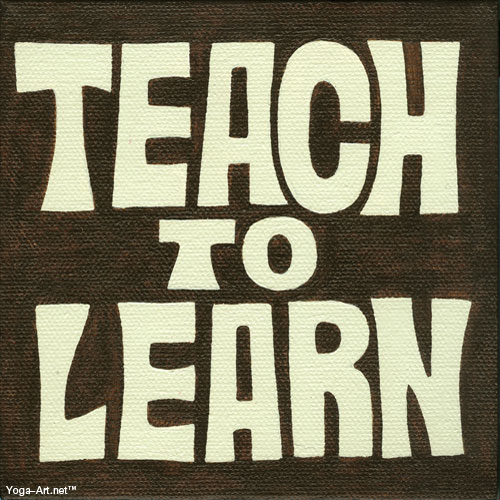
Angelos Morenao, Yoga-Inspired Art

Angelos Morenao, Yoga-Inspired Art, Yoga-Art.net

Approaching a complex organizational performance need in this way has several benefits:

  • Empowers active learning
  • Teaching, by its very nature, reinforces and deepens learning
  • Builds collaboration and organizational learning culture – learners are in it together
  • Creates internal experts for future help
  • Allows the trainer/ID to relax and let others do their work for them

Sadly, that last point is not even remotely true. But, it does make us approach our role quite differently. Rather than tight authority over a specific e-learning track or training room, we open our controlling fist to the chaos of the crowd. What that means is we become curators, coaches, mentors and evaluators.

  • Curate: We provide the materials, links, and other resources that are going to allow learners to build and contextualize their growing expertise in their area.
  • Coach: We want to monitor, redirect and reward learning along the way; in particular, we will need to guide how they intend to teach what they are learning. Training is hard, and we know it is a skill that many don’t have naturally. So…
  • Mentor: We need to work with individuals to find their strengths in how to present the content (talking, demonstrating, visual depiction, metaphoric illustration, interpretive dance, etc.).
  • Evaluate: Was our flipped method successful? What follow-ups, resources and continuous learning scaffolds need to be in place to build on both the content and the learning culture that has taken root? (Seems like a great place to start an online Community of Practice, but that is a topic for/from another day.)

Seen this way, our job is less to prepare and deliver training “products” or “events,” and more about adjusting to a digital age learning culture. The constant stream of information is relentless, and we need to help our learners make sense of it and flourish beneath the deluge.

Anthropology and ID: Design for people and the culture they work in

24 Feb
donfaye

Don Draper and Dr. Faye Miller, on Mad Men. She taught him to be at least a little human-centric… a lesson that didn’t take. (AMCTV)

I’m not the first to see the strong ties between instructional design and social–ethnographic anthropology. But, a commercial application that evolved out of the marketing and advertising industries of the 1960s (thanks, Don Draper and his one-time love interest, Faye Miller, PhD.) has crept into numerous fields concerned with how people move through their environment and make sense of the information that confronts them. Instructional Design is no exception. However, you won’t be  shocked to hear it is an under-applied framework in our field of adult learning.

When we take the time to observe, catalog and empathize with our e-learning cohort, we can much better prepare and deliver the desired learning, and their anticipated outcomes. In very broad strokes, these fall into three main categories:

TIME/SPACE

I’ve been part an embarrassingly high number of e-learning projects that did very little examination of when the end-learners would consume the learning. On the job? At home? On the go (mobile)? In a quiet space to allow thoughtful contemplation, or in a chaotic loud environment? Know your learners, and design for where and when they learn as much as how they learn.

PRIORITY

Priority splits into two parts: Organizational priority (and possible compulsion) and individual priority, the latter being an individual judgment of perceived value and applicability.

If it is an organizational priority, be it compliance, orientation/acculturation, or as part of a new systems or process roll out, then the job of motivation is simple. But, the job of meaningful execution to make relevant and applicable is pressure-packed for the instructional design and training team: It better be good, engaging, and fun, or the organization will at you when the learning is not applied on the job.

If it is an individual priority, great! Half the battle is won. However, how are folks categorizing, applying, and sharing their self-motivated knowledge? In other words, how does individual learning benefit organizational knowledge and leaning, and vice-versa? This is truly an anthropological question indeed. What kind of community is it? Hyper-competitive? Team-driven all-for-one-and-one-for-all? There are advantages to either, but we had better understand the working culture to roll out effective initiatives and tools to enhance the organizational mission.

PLATFORM

How will the instruction be delivered? Is it necessary to have folks outside of their normal work day, or can it be integrated into the flow? There is a common idea among software developers that is coined as “being close to the machine.” The way we should approach instruction should be analogous to that: As much as possible align instruction to be a part of the activity into which it will be applied.

MargaretMead1

Margaret Mead

Integration can be a challenge for us – especially those of us that are used to our “training space.” We may have to shift to more job aides and performance support. Ultimately, we are servants to the end goal of application, not knowledge, and so the delivery platform(s) we choose should be as close to the time of need of application as possible.

To put a little Margaret Mead into your next learning project, start by putting the design back into instructional design.

In short, applying an anthropological lens to our work places the emphasis squarely on design. Design, after all, places human- (and user-) centric experiences at the forefront: Instructional Design (ID) as a distinct practice parallel but apart from Instructional Systems Design (ISD).