Archive | Information Fluency RSS feed for this section

Webbie Winners: Are IDs and e-learning folks keeping up?

4 Mar
lifesaver uk

From life-saver.org.uk — an amazing interactive learning video. It takes a while to load, though.

I had the good fortune to squeeze out 45 minutes to breeze over the latest Webbie Award 2013 winners. It was not nearly enough. However, as is my habit, I diligently clipped the winners or nominees that drew my eye to something that might be applicable to e-learning and learner engagement. This is a great example of how and why I am so enthusiastic about PKM (Personal Knowledge Management). But that is a topic for another day.

So, what can e-learning practitioners glean from Webbie winners?

Trends:

The digital native advantage: Integrate the world into e-learning

26 Sep

In most organizations, learners spend much of their day in front of the screen. Don’t fear that email, the Internet, Twitter, et. al., will distract learners from your module: Of course it will!

However, what was a worry, with some holistic thinking, can become an asset (see Lessons 1 – 4). Flip the scene to imagine how social learning, the organizational intranet or forum feed, and the larger on-screen window-to-the-world become an asset to your e-learning goals.

monitor-68156_640

E-learning is only one small stream reaching your learner. Learn to employ the full spectrum.

A learner, even if taken away from his computer for coursework  at a dedicated “e-learning terminal” carries the world with him in his mind (not to mention phones and tablets!). It is beneficial, if done thoughtfully, to invite the world at his fingertips into the course. Make a browser search part of a directed activity. Require that he IM his manager at key points throughout the e-learning course. Perhaps he’ll be directed to add to the intranet forum on the given topic. Why not? Learning is not separate from, but an important part of his working life. The outside world is not a threat if we bend it to our needs.

What’s more, for many topics the tool he uses to train on – his computer – is the same tool he uses to complete tasks. All the better! He is much more apt to remember and transfer his e-learning lesson when he is supported by the same visual and environmental cues that were there when he first learned it.

Collaboration as Learning? Collaboration IS Learning (or certainly should be!)

9 Jul

I’ve discussed in earlier posts my strong belief that learning is based in discourse. Through conversation, examination, doubt and reaffirmation we arrive to that place where we are confident in our understanding, our knowledge that we’ve learned something significant. Even if it is internal dialog, there is no substitute for point – counter-point.

It seems like a logical extension then, that the waves of tools, systems and organizational necessities to make collaboration more effective would take us a good distance towards learning workers and learning organizations.  But, for many of us, that has been far from the case.

The more often I speak into a triangular phone, the more I stare at the moving mouse of a screencast or web meeting, the less I feel like I am collaborating (or learning!). Why? Peter Senge, the godfather of learning organizations, had an interesting post the other day about this very topic. Real Collaboration Takes More than Meetings and PowerPoints dives into the heart of this conundrum.

The main takeaway of his post is that collaboration takes deliberate effort, and a workplace culture that demands it. Collaboration should not be, in fact cannot be, passive.

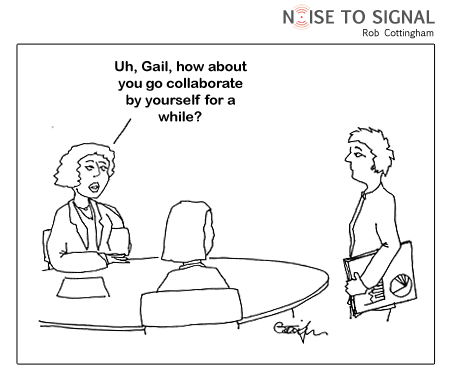
Rob Cottingham, via timesunion.com

Rob Cottingham, via timesunion.com

Collaboration is an act, a participation in a conversation that, if well-managed, drives to reveal facts and decision points. As Senge points out in one good example,

Practices for fostering thinking together need to be embedded in meetings as well. Whenever any of these networks meet, there are few “PowerPoint shows.” The vast majority of the time is spent in small working sessions and larger plenary dialogues….

Yes, our old friend dialog. It what makes the first Star Wars movie so much better than all the rest.

Hmmmm…. Active, engaged, participatory, the very opposite of passivity: Gosh, that sounds a lot like what trainers and Instructional Designers say all the time! Right, collaboration is learning when done well. If you have nothing to learn, and nothing to share, then why collaborate at all? The key is to manage the time, tools and cultural expectations to allow learning to happen.

Digital Curation as Learning Outcome

16 May

I was reading eLearning Magazine’s dispatches from the Learning Solutions 2013 conference, and appreciated a list they put together that encapsulated “Key Strategic Shifts to Watch.” After reading it through and giving it some thought, they really add up to one major shift in the way we should approach online learning: Learners taking control of their own learning.

I’ve touched on this topic before, but it warrants a deeper dive.

Information is not hard to find. Facts, ideas, hypotheses, art, opinions, stories, mendacities are impossible visitusto avoid. We are awash in digital content! There has been a lot of talk in the last decade of moving from “media literacy” to “digital literacy,” or what the terrific iDesign team at University of Alaska –Fairbanks have dubbed “Information Fluency.”

I could not agree more. Learners, from grade school through business leaders require the ability to sort through the sea of content to make sense of it all: Truth from fiction, actionable ideas from general knowledge, judgments from smears, opinions from facts. All of those are valuable content types—even smears—but through sorting comes understanding and eventually, knowledge.

But as I made the case before, knowledge is not my department.

What I am concerned about is how knowledge results in action (learning transfer). In other words, how does a learner demonstrate knowledge?

Participation. The smartest person in the room, her brain a repository of knowledge vast and deep, adds nothing if she chooses not to participate. In our business world, we know when someone is participating that results in adding value.

But in a learning environment, how do we measure that learning occurs? Formal assessments can, to certain degree, accomplish this. But adult learners have little appetite or patience for that—neither do kids, but too bad.

One useful, practical and engaging way for learners to take control of their own learning and to demonstrate learning transfer is by effectively curating their learning topic. Can the learner pull together digital artifacts that synthesize their learning into a meaningful content collection? Can the learner express how and why the collection hangs together, demonstrating the ability to both select useful content and to connect the dots into a coherent whole? If so, it’s a terrific way to demonstrate that learning has occurred outside an actual on-the-job problem-solving situation.

In fact, I have named my blog In The Learning Age in large part because ultimately information fluency is the central task we face no matter what our job descriptions might say. We need to be individual learners, and part of learning organizations, in order not to be left behind in this Learning Age. We are learning workers, and curation is a great tool for us – IDs, trainers, educators, PD professionals – to employ.

Check out both of these links below to read more about creating learning curators. I also invite you to check out my own attempt to curate content on my scoop.it page.

While both of these short, interesting pieces discuss scholastic applications, it is not much of a jump to see how they can be applied to training and professional development efforts, too.